GLP-1 / Unit conversion
Retatrutide reconstitution calculator
Enter your Retatrutide vial size, the volume of liquid added and the dose to calculate concentration and syringe units.
Your inputs determine the result. This calculator does not recommend dosages.
Set your draw.
Enter your vial strength, diluent, and dose to see the draw.
How this is converted
Conversion follows standard mg, mL, and U-100 syringe references.
Performs unit conversions only. Not medical advice. Consult your healthcare provider.
Units chart
Retatrutide units chart (mg to U-100 units)
Retatrutide units chart: mg to U-100 units
PinPoint groups retatrutide under GLP-1 and describes a compound with GLP-1, GIP, and glucagon receptor activity. The chart draws on a 10 mg example vial size (input).
Vial concentration
Water mL is treated as final solution mL in these columns.
| Vial contents | 1 mL water | 2 mL water | 3 mL water |
|---|---|---|---|
| 10 mg | 10 mg/mL10 U-100 units per mg | 5 mg/mL20 U-100 units per mg | 3.3333 mg/mL30 U-100 units per mg |
Example vial size (input): 10 mg. No source is cited for this size; it is an arithmetic input, not a sourced fact.
Amount to units
Example amounts (arithmetic only, not doses).
| Amount (mg) | 10 mg + 1 mL | 10 mg + 2 mL | 10 mg + 3 mL |
|---|---|---|---|
| 0.2 mg | 2 units | 4 units | 6 units |
| 0.5 mg | 5 units | 10 units | 15 units |
| 1 mg | 10 units | 20 units | 30 units |
| 2 mg | 20 units | 40 units | 60 units |
| 5 mg | 50 units | 100 units | 150 unitsover one syringe |
Cited amounts
No human dose has been established. The amount table contains arithmetic examples only.
How to read this chart
units = amount ÷ (vial mg ÷ water mL) × 100
The reconstitution calculator walks through each step, and units to mg converts between mg, mcg, mL and units.
A six-day decay reference
The app's retatrutide half-life input is 144 hours, which converts to six days, the approximate half-life reported in the phase 1b study. Looking across consecutive weeks can show how several timestamped entries contribute to the estimated timeline. That is a time-based calculation using the record's stored parameters; the vial chart instead divides a fixed amount by a fixed liquid volume and does not depend on a log date.
Example vial, three concentrations
The example vial size (input) is 10 mg per retatrutide vial. Dividing that amount into 1, 2, or 3 mL produces the three concentration columns. For the 5 mg example row, the fraction of the vial is 0.5. It occupies 0.5 mL in the first column and 1.5 mL in the third, giving 50 and 150 U-100 units respectively. The over-one-syringe marker appears in the latter case because the calculated volume exceeds the chart's one-milliliter capacity reference.
Units, mL and mg/mL
Retatrutide dosage in units and mL
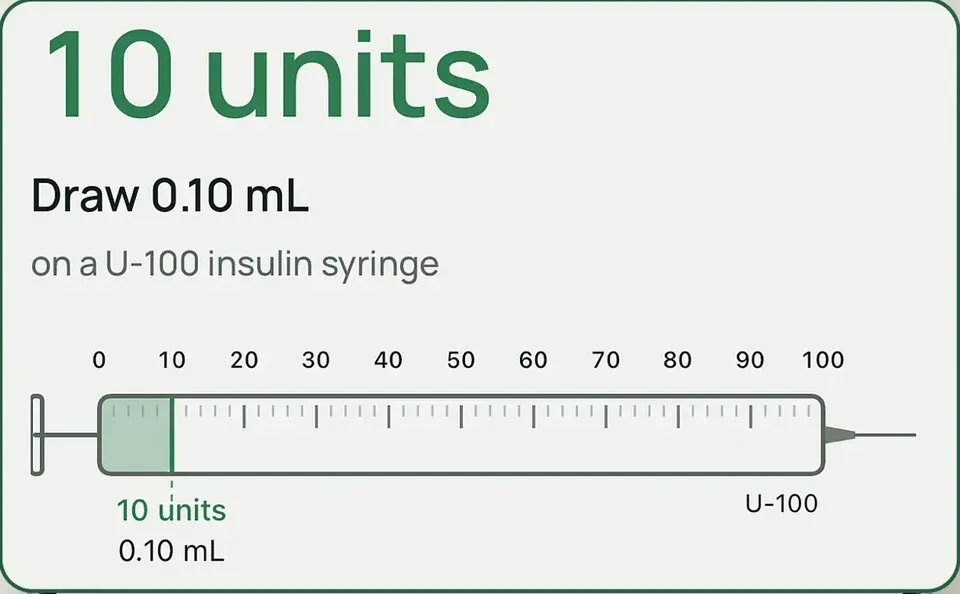
Searches for Retatrutide dosage in units or in mL are conversion questions. Units and mL both measure volume, and what a volume holds depends on how the vial was mixed. The first table gives the concentration of a 10 mg Retatrutide example vial (input) at 1, 2 and 3 mL of water; the second shows how many U-100 units each share of the vial takes, and what that share holds. Neither table sets a dose.
| Water added | Concentration | Units per 1 mg | 10 units (0.1 mL) holds |
|---|---|---|---|
| 1 mL | 10 mg/mL10,000 mcg/mL | 10 units0.1 mL | 1 mg1,000 mcg |
| 2 mL | 5 mg/mL5,000 mcg/mL | 20 units0.2 mL | 0.5 mg500 mcg |
| 3 mL | 3.33 mg/mL3,333.33 mcg/mL | 30 units0.3 mL | 0.3333 mg333.3 mcg |
| Fraction of the vial | Holds | Units in 1 mL | Units in 2 mL | Units in 3 mL |
|---|---|---|---|---|
| 1/20 one twentieth | 0.5 mg500 mcg | 5 units 0.05 mL | 10 units 0.1 mL | 15 units 0.15 mL |
| 1/10 one tenth | 1 mg1,000 mcg | 10 units 0.1 mL | 20 units 0.2 mL | 30 units 0.3 mL |
| 1/5 one fifth | 2 mg2,000 mcg | 20 units 0.2 mL | 40 units 0.4 mL | 60 units 0.6 mL |
| 1/4 one quarter | 2.5 mg2,500 mcg | 25 units 0.25 mL | 50 units 0.5 mL | 75 units 0.75 mL |
| 1/2 one half | 5 mg5,000 mcg | 50 units 0.5 mL | 100 units 1 mL | 150 units 1.5 mL over one 100-unit syringe |
Retatrutide 10 mg reconstitution: worked example
A 10 mg Retatrutide vial mixed with 2 mL of bacteriostatic water holds 5 mg/mL, or 5,000 mcg/mL. On a U-100 syringe 10 units is 0.1 mL, and at this concentration it holds 0.5 mg (500 mcg), one twentieth of the vial. The whole 10 mg is 200 units at 2 mL, more than one 100-unit syringe holds. Mixed with 1 mL instead, the vial is 10 mg/mL and 10 units hold 1 mg; with 3 mL it is 3.33 mg/mL and 10 units hold 0.3333 mg.
Retatrutide has no label, so there are no manufacturer mixing instructions. The how to reconstitute peptides guide explains why arithmetic cannot supply a volume, and the research section below covers what the sources report.
Arithmetic from the example vial size (input) shown, not doses. Water mL is treated as the final volume; a different vial entered in the calculator above gets the same formulas.
Compound profile
Retatrutide at a glance
Retatrutide is an investigational peptide that activates GIP, GLP-1, and glucagon receptors, studied in metabolic disease.[1] PinPoint's library draws on human research for a long-duration tracking reference and retains its investigational status.
- Regulatory status
- Retatrutide is not FDA-approved; it is an investigational drug in clinical trials.[1][2]
- Half-life
- Approximately 6 days, measured in adults with type 2 diabetes given once-weekly subcutaneous injections in the phase 1b study.[1]
- Route
- Subcutaneous injection in the cited studies.[1]
- Category
- GLP-1
- Vial size
- 10 mg, example vial size (input)
Retatrutide's triple-receptor identity and investigational status remain central to the page. A 144-hour reference supplies a model scale; a 10 mg example vial size supplies an input total for arithmetic. Neither source transforms the other into a labeled personal plan or a preparation instruction.[1]
Evidence
What the research says
The cited phase 1b study investigated retatrutide, then identified as LY3437943, in adults with type 2 diabetes. Seventy-two participants received study treatment across active, placebo, and dulaglutide groups. The 12-week design used subcutaneous injections and examined multiple ascending exposure levels under controlled research conditions.[1]
Safety and tolerability were the primary outcomes. Investigators also measured pharmacokinetics, daily plasma glucose, HbA1c, and body weight. Retatrutide exposure was dose proportional, and the reported half-life was approximately six days, providing the research context for the library's extended timing input.[1]
The publication describes an early study, with 29 participants discontinuing before completion. Its metabolic findings and adverse-event observations belong to that design and population. The triple receptor identity refers to GIP, GLP-1, and glucagon activity; it does not make retatrutide interchangeable with dual- or single-receptor compounds.[1]
What retatrutide doses did the published studies report?
The first multiple-dose study, a phase 1b study in adults with type 2 diabetes published in 2022, gave once-weekly subcutaneous injections for 12 weeks in five ascending cohorts from 0.5 mg up to an escalated 12 mg, with the two highest cohorts reached through stepwise increases (3/6 mg and 3/6/9/12 mg) [1].
The phase 2 obesity study randomised 338 adults to placebo or once-weekly subcutaneous retatrutide at 1 mg, 4 mg, 8 mg or 12 mg for 48 weeks [4]. The 4 mg and 8 mg arms each had versions with a 2 mg or a 4 mg initial amount, and the 12 mg arm began at 2 mg. Gastrointestinal events were the most common adverse events; they were dose related and were partly reduced by the lower initial amount [4].
A parallel phase 2 study in people with type 2 diabetes compared retatrutide with placebo and with an approved GLP-1 receptor agonist [5]. None of these papers converts its arms into instructions for an individual; they report what investigators assigned under monitoring.
Timing
Half-life and timing
Approximately 6 days, measured in adults with type 2 diabetes given once-weekly subcutaneous injections in the phase 1b study.[1]
Six days per halving yields a 30-day span for five halvings. The intervening points place 25% at day 12 and 6.25% at day 24. At day 30 the starting quantity is reduced to 3.125%, rather than to zero. This is deliberately arithmetic-only: it excludes accumulation from multiple entries and any absorption phase. The library's study-context estimate remains an estimate throughout, so the clean month-long axis cannot establish a personal washout interval or a retatrutide dosing schedule.
The cited half-life reference
Clinical publication: approximately six-day half-life and subcutaneous exposure, used for tracking only. The arithmetic below uses 144 hours (6 days); it is not a measurement of anyone's levels or of how long an effect lasts.[1]
The six-day input places retatrutide between the five-day tirzepatide reference and the seven-day semaglutide reference in this library. That ordering compares model timing only. It says nothing about relative effects, appropriate amounts, or interchangeability. A seven-day calendar marker comes just after one modeled half-life. The library source identifies a clinical publication and explicitly limits the stored values to tracking; the arithmetic here retains that distinction.[1]
Half-life varies with the person, formulation and study context. The library source note states approximately six days and does not supply a numerical range.
Retatrutide decay table
Starting at an arbitrary 100%, each elapsed half-life divides the remaining modeled amount by two: 100 × 2 raised to the power of minus elapsed hours divided by 144. It describes a single contribution with no additional entries, and the percentages are not percentages of benefit or activity. Five half-lives, 720 hours (30 days), leave 3.125%; decay never reaches zero, and this is not a detection window or washout instruction.
| Half-lives | Hours | Days | Remaining (rounded) |
|---|---|---|---|
| 0 | 0 | 0 | 100.0% |
| 1 | 144 | 6 | 50.0% |
| 2 | 288 | 12 | 25.0% |
| 3 | 432 | 18 | 12.5% |
| 4 | 576 | 24 | 6.3% |
Calculator details
About this calculation.
How much reconstitution solution for 10 mg retatrutide?
There is no water-volume choice inferred from the library's research citation. As arithmetic only, 10 mg divided by an assumed 2 mL gives 5 mg/mL. That assumption demonstrates the formula; it is not a preparation instruction or a retatrutide dosing schedule.
What can a retatrutide dosing schedule calculator infer from the vial size?
A vial total supports inventory and conversion math. It does not supply a studied sequence of clinical amounts or timing. The library's investigational research status remains unchanged when a calculator produces a precise-looking milliliter result.
Why does a retatrutide chart still show a fraction after 30 days?
Thirty days contains five of the stored six-day intervals. Repeated halving gives one thirty-second, or 3.125%, of the hypothetical starting quantity. The model never reaches exact zero at that point, and the calculation does not measure a person's concentration.
What retatrutide dosing schedule did the studies use?
The three multiple-dose studies discussed here administered retatrutide once weekly by subcutaneous injection. In the phase 2 obesity study, arms reached 4, 8 or 12 mg from an initial 2 mg or 4 mg amount, and one arm stayed at 1 mg for 48 weeks. That is a research design, not a personal schedule.[1][4][5]
What concentration is Retatrutide at 10 mg in 1 mL?
10 mg divided by 1 mL is 10 mg per mL. That volume spans 100 U-100 syringe units.
How does 2 mL change the concentration of this Retatrutide vial?
10 mg divided by 2 mL is 5 mg per mL, half the concentration in the 1 mL column.
What does the 3 mL column mean for Retatrutide?
10 mg divided by 3 mL is approximately 3.3333 mg per mL. The full 3 mL volume corresponds to 300 U-100 units.
How many units is 1 mg of Retatrutide from this vial in 2 mL?
1 mg divided by 5 mg per mL is 0.2 mL, or 20 U-100 units.
References
Sources
Sources checked against the cited documents on 19 November 2026.
- Phase 1b study of LY3437943 (retatrutide) in type 2 diabetes, 2022 (PubMed 36354040)Abstract read 19 November 2026; the full text is paywalled.Retrieved 2026-11-19 · human-study
- Drugs@FDA (openFDA), search for retatrutideNo retatrutide application found (searched by ingredient and generic name).Retrieved 2026-11-19 · regulator
- PinPoint App Store descriptionFeature wording from the approved application description, not pricing.Retrieved 2026-10-05 · app-description
- Retatrutide phase 2 obesity study, 2023N Engl J Med, 2023. Once-weekly 1, 4, 8 and 12 mg arms with 2 mg or 4 mg initial doses, 48 weeks.Retrieved 2026-10-05 · study
- Retatrutide phase 2 study in type 2 diabetes, 2023The Lancet, 2023. Randomised, placebo and active-controlled phase 2 study.Retrieved 2026-10-05 · study
From the same library
Related calculators
Keep your protocol together
Track the result in the app.
Set up vials, log doses and sites, and see your next reminder in PinPoint for iOS.

Keep exploring
More tools
- Peptide tracker app Trackers
- GLP-1 tracker app GLP-1
- TRT tracker app Trackers
- Compare trackers Compare
- Peptide calculator Vial, dose and syringe unit math.
- Reconstitution calculator Any powder vial: mg/mL, mL and units.
- BPC-157 TB-500 blend calculator Two peptides in one vial: mg per draw and units.
- KLOW peptide blend calculator KPV, GHK-Cu, BPC-157 and TB-500 in one vial.
- GLOW peptide blend calculator GHK-Cu, BPC-157 and TB-500 in one vial.
- CJC-1295 ipamorelin calculator Two-peptide vial: mcg per draw and units.
- AOD-9604 calculator Reconstitution, concentration and units.
- BPC-157 calculator Reconstitution, concentration and units.
- Cagrilintide calculator Reconstitution, concentration and units.
- CJC-1295 (no DAC) calculator Reconstitution, concentration and units.
- CJC-1295 (with DAC) calculator Reconstitution, concentration and units.
- DSIP calculator Reconstitution, concentration and units.
- GHK-Cu calculator Reconstitution, concentration and units.
- HCG calculator Reconstitution, concentration and units.
- IGF-1 LR3 calculator Reconstitution, concentration and units.
- Ipamorelin calculator Reconstitution, concentration and units.
- MOTS-c calculator Reconstitution, concentration and units.
- PT-141 calculator Reconstitution, concentration and units.
- Semaglutide calculator Reconstitution, concentration and units.
- Sermorelin calculator Reconstitution, concentration and units.
- TB-500 calculator Reconstitution, concentration and units.
- Tesamorelin calculator Reconstitution, concentration and units.
- Tirzepatide calculator Reconstitution, concentration and units.
- Peptide dosing chart Compare vial concentrations and amount-to-units tables across the compound charts.
- Units to mg calculator Convert U-100 syringe units, mg and mL using your own concentration.
- TRT dose calculator Divide weekly mg into amounts and volumes per injection at a known concentration.
- GLP-1 guides GLP-1
- GLP-1 injection sites GLP-1
- GLP-1 doses in units and mL GLP-1
- Tirzepatide dose schedule GLP-1
- Peptide library Guides
- Liraglutide guide Guides
- Somatropin guide Guides
- SS-31 guide Guides
- Learn explainers Learn
- KLOW peptide blend explained Learn
- BPC-157 and TB-500 explained Learn
- SS-31 and MOTS-c explained Learn
- HGH and somatropin, IU to mg Learn
- Levocarnitine explained Learn
- VIP peptide and aviptadil explained Learn
- CagriSema explained Learn
Your next chapter starts here
Start Day 1 with
your numbers in place.
Your doses, your schedule, your picture. Bring it together in PinPoint.
Built for iPhone.
Subscription through the App Store, cancel anytime in your Apple ID settings.