Cellular research / Unit conversion
NAD+ reconstitution calculator
Enter your NAD+ vial size, the volume of liquid added and the dose to calculate concentration and syringe units.
Your inputs determine the result. This calculator does not recommend dosages.
Set your draw.
Enter your vial strength, diluent, and dose to see the draw.
How this is converted
Conversion follows standard mg, mL, and U-100 syringe references.
Performs unit conversions only. Not medical advice. Consult your healthcare provider.
Units chart
NAD+ units chart (mg to U-100 units)
NAD+ units chart: mg to U-100 units
NAD+ has a 500 mg example vial size (input) in PinPoint; that amount comes from no study. Every row below is arithmetic on that container total and a chosen liquid volume, nothing more.
Vial concentration
Water mL is treated as final solution mL in these columns.
| Vial contents | 1 mL water | 2 mL water | 3 mL water |
|---|---|---|---|
| 500 mg | 500 mg/mL0.2 U-100 units per mg | 250 mg/mL0.4 U-100 units per mg | 166.6667 mg/mL0.6 U-100 units per mg |
Example vial size (input): 500 mg. No source is cited for this size; it is an arithmetic input, not a sourced fact.
Amount to units
Example amounts (arithmetic only, not doses).
| Amount (mg) | 500 mg + 1 mL | 500 mg + 2 mL | 500 mg + 3 mL |
|---|---|---|---|
| 10 mg | 2 units | 4 units | 6 units |
| 25 mg | 5 units | 10 units | 15 units |
| 50 mg | 10 units | 20 units | 30 units |
| 100 mg | 20 units | 40 units | 60 units |
| 250 mg | 50 units | 100 units | 150 unitsover one syringe |
Cited amounts
No human dose has been established. The amount table contains arithmetic examples only.
How to read this chart
units = amount ÷ (vial mg ÷ water mL) × 100
The reconstitution calculator walks through each step, and units to mg converts between mg, mcg, mL and units.
Where the 500 mg figure comes from
The library's 500 mg figure is an example vial size (input), kept on 5 October 2026. It is not a sourced product fact. It says nothing about purity, solubility, preparation or any amount used in people. The chart divides that total by 1, 2 and 3 mL so the volume arithmetic can be checked; a container of another size would change every row.
What the infusion study does and does not supply
The NAD+ library annotation cites a six-hour intravenous infusion in people. That study observed infused NAD+ leaving plasma rapidly, and it supplied no numeric pharmacokinetic inputs: no elimination half-life, no absorption fraction and no time to peak. The app's model inputs for NAD+ are authored tracking estimates rather than values from the paper, and this chart does not use them. The study gave 750 mg of NAD+ by intravenous infusion over 6 hours to 8 men; it used no vial for injection and no subcutaneous route. No human dose has been established for subcutaneous use.
Why a 500 mg vial changes the scale
The BPC-157 library entry, for comparison, holds 5 mg. The NAD+ example vial holds 500 mg, so at the same volume its concentrations are a hundred times larger. At 1 mL the arithmetic gives 500 mg per mL, which is a number on paper; the chart does not claim that this much powder dissolves in that volume. The 3 mL column lowers the figure to about 166.7 mg per mL.
Reading the example rows
The example amounts are one fiftieth, one twentieth, one tenth, one fifth and one half of the vial: 10, 25, 50, 100 and 250 mg. In 2 mL of liquid, 50 mg occupies 0.2 mL, or 20 U-100 syringe units, and 250 mg fills a full 1 mL syringe. These rows divide the container into fractions and stay arithmetic. No cited human amount is listed for NAD+, and none of these rows is drawn from the infusion study, which gave 750 mg by intravenous infusion over 6 hours.
Compound profile
NAD+ at a glance
NAD+, nicotinamide adenine dinucleotide, is a coenzyme whose direct infusion has been followed in a pilot study in 11 men (8 infused, 3 saline controls).[1]
- Regulatory status
- NAD+ is not an FDA-approved drug; FDA lists nicotinamide adenine dinucleotide among bulk substances still under evaluation for pharmacy compounding (section 503A, category 1, list updated 14 May 2026).[2]
- Half-life
- No published half-life value exists for NAD+ in this form.
- Route
- Intravenous infusion over 6 hours in the cited pilot study; the app logs NAD+ as a subcutaneous entry.[1]
- Category
- Cellular research
- Vial size
- 500 mg, example vial size (input)
The single human reference measured an intravenous infusion, while the app logs subcutaneous entries. The 500 mg figure is an example vial size (input) and carries no clinical meaning beyond the size of that container.[1]
Evidence
What the research says
The cited pilot study gave NAD+ by intravenous infusion over six hours and sampled plasma and urine during and after the infusion. Its stated purpose was to document what happens to directly infused NAD+ in people, because earlier human work had concentrated on precursor molecules such as nicotinamide riboside.[1]
The authors report that plasma NAD+ and its measured metabolites did not change for roughly the first two hours, which they interpret as rapid and complete removal of infused NAD+ from plasma at that infusion rate. Urinary NAD+ and methylnicotinamide rose by the sixth hour. The metabolite pattern is described as consistent with enzymatic breakdown of the dinucleotide.[1]
The study calculated no half-life, absorption fraction or time to peak. It reported no rise in plasma NAD+ during the first 2 hours of the infusion and a rise to about 400% above baseline by 6 hours. The route the app models, subcutaneous, differs from the route the paper measured.[1]
Timing
Half-life and timing
No published half-life value exists for NAD+ in this form.
Calculator details
About this calculation.
Does the NAD+ infusion study give a subcutaneous half-life?
No. It followed a six-hour intravenous infusion and did not calculate a half-life. The study reported no rise in plasma NAD+ during the first 2 hours of the infusion and a rise to about 400% above baseline by 6 hours.[1]
What does a NAD+ reconstitution calculator compute from a 500 mg vial?
It divides the vial total by the liquid volume you enter and converts a chosen amount into millilitres and U-100 syringe units. The arithmetic is the same as for any powder vial. It does not choose the amount or account for how NAD+ behaves after injection.
What concentration is NAD+ at 500 mg in 1 mL?
500 mg divided by 1 mL is 500 mg per mL. That volume spans 100 U-100 syringe units.
How does 2 mL change the concentration of this NAD+ vial?
500 mg divided by 2 mL is 250 mg per mL, half the concentration in the 1 mL column.
What does the 3 mL column mean for NAD+?
500 mg divided by 3 mL is approximately 166.6667 mg per mL. The full 3 mL volume corresponds to 300 U-100 units.
How many units is 50 mg of NAD+ from this vial in 2 mL?
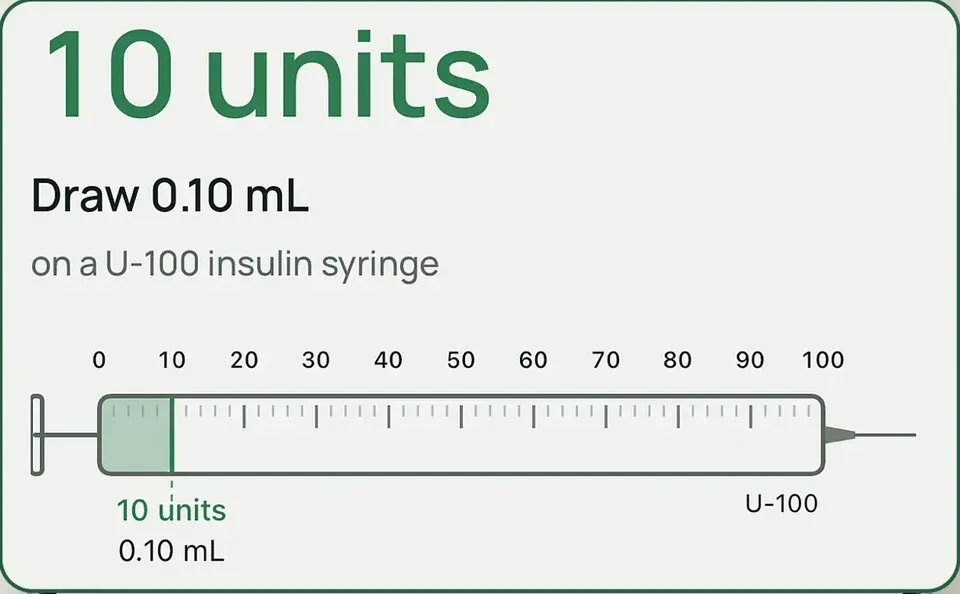
50 mg divided by 250 mg per mL is 0.2 mL, or 20 U-100 units.
References
Sources
Sources checked against the cited documents on 19 November 2026.
- Intravenous NAD+ infusion pilot study in 11 men, 2019 (PubMed 31572171; open-access full text PMC6751327)Abstract and open-access full text read 19 November 2026. The study supplied no numeric pharmacokinetic inputs.Retrieved 2026-11-19 · human-study
- FDA, Bulk Drug Substances Nominated for Use in Compounding Under Section 503A (list updated 14 May 2026)503A Category 1, bulk drug substances under evaluation: Nicotinamide Adenine Dinucleotide (NAD), p. 2.Retrieved 2026-11-19 · regulator
- PinPoint App Store descriptionFeature wording from the approved application description, not pricing.Retrieved 2026-10-05 · app-description
Keep your protocol together
Track the result in the app.
Set up vials, log doses and sites, and see your next reminder in PinPoint for iOS.

Keep exploring
More tools
- Peptide tracker app Trackers
- GLP-1 tracker app GLP-1
- TRT tracker app Trackers
- Compare trackers Compare
- Peptide calculator Vial, dose and syringe unit math.
- Reconstitution calculator Any powder vial: mg/mL, mL and units.
- BPC-157 TB-500 blend calculator Two peptides in one vial: mg per draw and units.
- KLOW peptide blend calculator KPV, GHK-Cu, BPC-157 and TB-500 in one vial.
- GLOW peptide blend calculator GHK-Cu, BPC-157 and TB-500 in one vial.
- CJC-1295 ipamorelin calculator Two-peptide vial: mcg per draw and units.
- AOD-9604 calculator Reconstitution, concentration and units.
- BPC-157 calculator Reconstitution, concentration and units.
- Cagrilintide calculator Reconstitution, concentration and units.
- CJC-1295 (no DAC) calculator Reconstitution, concentration and units.
- CJC-1295 (with DAC) calculator Reconstitution, concentration and units.
- DSIP calculator Reconstitution, concentration and units.
- GHK-Cu calculator Reconstitution, concentration and units.
- HCG calculator Reconstitution, concentration and units.
- IGF-1 LR3 calculator Reconstitution, concentration and units.
- Ipamorelin calculator Reconstitution, concentration and units.
- MOTS-c calculator Reconstitution, concentration and units.
- PT-141 calculator Reconstitution, concentration and units.
- Retatrutide calculator Reconstitution, concentration and units.
- Semaglutide calculator Reconstitution, concentration and units.
- Sermorelin calculator Reconstitution, concentration and units.
- TB-500 calculator Reconstitution, concentration and units.
- Tesamorelin calculator Reconstitution, concentration and units.
- Tirzepatide calculator Reconstitution, concentration and units.
- Peptide dosing chart Compare vial concentrations and amount-to-units tables across the compound charts.
- Units to mg calculator Convert U-100 syringe units, mg and mL using your own concentration.
- TRT dose calculator Divide weekly mg into amounts and volumes per injection at a known concentration.
- GLP-1 guides GLP-1
- GLP-1 injection sites GLP-1
- GLP-1 doses in units and mL GLP-1
- Tirzepatide dose schedule GLP-1
- Peptide library Guides
- Liraglutide guide Guides
- Somatropin guide Guides
- SS-31 guide Guides
- Learn explainers Learn
- KLOW peptide blend explained Learn
- BPC-157 and TB-500 explained Learn
- SS-31 and MOTS-c explained Learn
- HGH and somatropin, IU to mg Learn
- Levocarnitine explained Learn
- VIP peptide and aviptadil explained Learn
- CagriSema explained Learn
Your next chapter starts here
Start Day 1 with
your numbers in place.
Your doses, your schedule, your picture. Bring it together in PinPoint.
Built for iPhone.
Subscription through the App Store, cancel anytime in your Apple ID settings.