Peptide / Unit conversion
MOTS-c reconstitution calculator
Enter your MOTS-c vial size, bacteriostatic water volume and dose to calculate concentration and syringe units.
Your inputs determine the result. This calculator does not recommend dosages.
Set your draw.
Enter your vial strength, diluent, and dose to see the draw.
How this is converted
Conversion follows standard mg, mL, and U-100 syringe references.
Performs unit conversions only. Not medical advice. Consult your healthcare provider.
Library reference
MOTS-c at a glance
Reference values from the PinPoint compound library, not a recommended schedule.
- Category
- Peptide
- Half-life
- 3 hours
- Administration routes
- Subcutaneous
- Listed frequencies
- Three times weekly, Five times weekly
The calculation
How the math works
Concentration = vial amount ÷ water mL
Draw volume = dose amount ÷ concentration
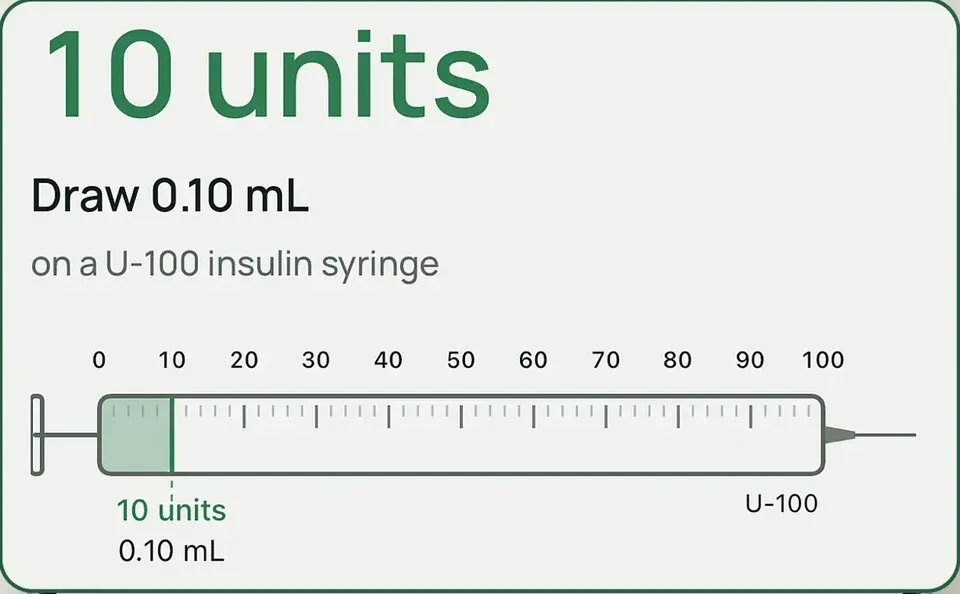
U-100 units = draw mL × 100
Units chart
MOTS-c units chart (mg to U-100 units)
MOTS-c units chart: mg to U-100 units
MOTS-c has a 10 mg vial reference and a three-hour half-life input in PinPoint. Its peptide record is labeled Research use only. The library's description centers the preclinical basis of the model and the absence of characterized human response information in that reference.
Vial concentration
Water mL is treated as final solution mL in these columns.
| Vial contents | 1 mL water | 2 mL water | 3 mL water |
|---|---|---|---|
| 10 mg | 10 mg/mL10 U-100 units per mg | 5 mg/mL20 U-100 units per mg | 3.3333 mg/mL30 U-100 units per mg |
Example vial size (input): 10 mg. No package source is cited; the size is an arithmetic input, not a sourced fact.
Amount to units
Example amounts (arithmetic only, not doses).
| Amount (mg) | 10 mg + 1 mL | 10 mg + 2 mL | 10 mg + 3 mL |
|---|---|---|---|
| 0.2 mg | 2 units | 4 units | 6 units |
| 0.5 mg | 5 units | 10 units | 15 units |
| 1 mg | 10 units | 20 units | 30 units |
| 2 mg | 20 units | 40 units | 60 units |
| 5 mg | 50 units | 100 units | 150 unitsover one syringe |
Cited amounts
No human dose figure is shown for MOTS-c, which has no human approval recorded in the PinPoint library; the amount table contains arithmetic examples only.
How to read this chart
Find the concentration column. Divide the amount by that concentration. Multiply the mL value by 100 for U-100 units. Match the amount units before dividing.
units = amount ÷ (vial mg ÷ water mL) × 100
Amount and volume
One mg equals 1,000 mcg; 100 U-100 units equals 1 mL. Concentration connects amount to volume. Read the full conversion guide.
Preclinical context for a numerical profile
The MOTS-c source annotation identifies a peer-reviewed preclinical discovery reference and says no published human reference source was found for the model. PinPoint marks the pharmacokinetic inputs as low confidence. That context is part of the record, even though the fields themselves are ordinary numbers that software can use to draw a curve. The chart does not need a human absorption estimate to divide 10 mg by 2 mL; it uses the documented package total and the displayed liquid-volume assumption.
Three hours is not a weekly frequency
The stored half-life for MOTS-c is three hours. In contrast, its common-frequency array contains Three times weekly and Five times weekly. Those counts describe how events may be distributed through a calendar week, not the duration of a modeled event. A dated log becomes more informative when the individual clock times remain attached, because an hourly curve can occupy a small part of the gap between entries. The three-hour field sets that elimination reference regardless of how many events appear in the weekly view.
What the ten-percent field represents
MOTS-c's base bioavailability coefficient is 0.10, equivalent to 10%, and its time-to-peak input is one hour. The library lists subcutaneous as the route and compounded vial as the delivery form. These entries support the app's time-based tracking estimate. They do not mean a 10 mg vial contains only 1 mg for concentration purposes: the full documented amount is still the numerator in the table. Keeping the model coefficient separate from package contents prevents two different uses of an amount from being combined into one conversion.
One fifth of the example vial
The MOTS-c example vial size (input) is 10 mg per vial. The five example amounts are 0.2, 0.5, 1, 2, and 5 mg. One fifth of the total is 2 mg, which gives 0.2 mL in the 1 mL column and 0.6 mL in the 3 mL column. The corresponding 20 and 60 U-100 units therefore describe the same fraction of two differently concentrated solutions. The smallest 0.2 mg row is one fiftieth of the vial, not a percentage taken from the model's bioavailability field.
Calculator details
About this calculation.
Does this page recommend a MOTS-c dose?
No. The calculator only converts the vial amount, water volume, and dose you enter. It does not provide dosing guidance, diagnosis, or treatment recommendations.
What is the half-life of MOTS-c?
PinPoint's compound library lists MOTS-c with a half-life of 3 hours. The app uses this value to estimate levels between logged doses.
How do I use the calculator for MOTS-c?
Enter your vial amount and dose in mg, mcg, IU or mL, and the BAC water you added in mL. The readout shows concentration, draw volume, U-100 syringe units, and doses per vial.
Where does this data come from?
From the compound library inside the PinPoint iOS app. The same values power dose logging and level tracking in the app.
What concentration is MOTS-c at 10 mg in 1 mL?
10 mg divided by 1 mL is 10 mg per mL. That volume spans 100 U-100 syringe units.
How does 2 mL change the concentration of this MOTS-c vial?
10 mg divided by 2 mL is 5 mg per mL, half the concentration in the 1 mL column.
What does the 3 mL column mean for MOTS-c?
10 mg divided by 3 mL is approximately 3.3333 mg per mL. The full 3 mL volume corresponds to 300 U-100 units.
How many units is 1 mg of MOTS-c from this vial in 2 mL?
1 mg divided by 5 mg per mL is 0.2 mL, or 20 U-100 units.
From the same library
Related calculators
Keep your protocol together
Track the result in the app.
Set up vials, log doses and sites, and see your next reminder in PinPoint for iOS.

Keep exploring
More tools
- Peptide tracker app Trackers
- GLP-1 tracker app GLP-1
- TRT tracker app Trackers
- Compare trackers Compare
- Peptide calculator Vial, dose and syringe unit math.
- Reconstitution calculator Any powder vial: mg/mL, mL and units.
- BPC-157 TB-500 blend calculator Two peptides in one vial: mg per draw and units.
- KLOW peptide blend calculator KPV, GHK-Cu, BPC-157 and TB-500 in one vial.
- GLOW peptide blend calculator GHK-Cu, BPC-157 and TB-500 in one vial.
- CJC-1295 ipamorelin calculator Two-peptide vial: mcg per draw and units.
- AOD-9604 calculator Reconstitution, concentration and units.
- BPC-157 calculator Reconstitution, concentration and units.
- Cagrilintide calculator Reconstitution, concentration and units.
- CJC-1295 (no DAC) calculator Reconstitution, concentration and units.
- CJC-1295 (with DAC) calculator Reconstitution, concentration and units.
- DSIP calculator Reconstitution, concentration and units.
- GHK-Cu calculator Reconstitution, concentration and units.
- Gonadorelin calculator Reconstitution, concentration and units.
- HCG calculator Reconstitution, concentration and units.
- Hexarelin calculator Reconstitution, concentration and units.
- IGF-1 LR3 calculator Reconstitution, concentration and units.
- Ipamorelin calculator Reconstitution, concentration and units.
- Melanotan II calculator Reconstitution, concentration and units.
- PT-141 calculator Reconstitution, concentration and units.
- Retatrutide calculator Reconstitution, concentration and units.
- Semaglutide calculator Reconstitution, concentration and units.
- Sermorelin calculator Reconstitution, concentration and units.
- TB-500 calculator Reconstitution, concentration and units.
- Tesamorelin calculator Reconstitution, concentration and units.
- Tirzepatide calculator Reconstitution, concentration and units.
- Peptide dosing chart Compare vial concentrations and preset amounts across 21 compound charts.
- Units to mg calculator Convert U-100 syringe units, mg and mL using your own concentration.
- TRT dose calculator Divide weekly mg into amounts and volumes per injection at a known concentration.
- GLP-1 guides GLP-1
- GLP-1 injection sites GLP-1
- GLP-1 doses in units and mL GLP-1
- Tirzepatide dose schedule GLP-1
- Peptide library Guides
- Tirzepatide guide Guides
- Liraglutide guide Guides
- Somatropin guide Guides
- MOTS-c guide Guides
- Retatrutide guide Guides
- Melanotan II guide Guides
- SS-31 guide Guides
- IGF-1 LR3 guide Guides
- Learn explainers Learn
- Retatrutide dosing explained Learn
- IGF-1 LR3 explained Learn
- KLOW peptide blend explained Learn
- MOTS-c dosage explained Learn
- 5-Amino-1MQ explained Learn
- BPC-157 and TB-500 explained Learn
- GHK-Cu dosage explained Learn
- SS-31 and MOTS-c explained Learn
- HGH and somatropin, IU to mg Learn
- Cerebrolysin explained Learn
- Levocarnitine explained Learn
- VIP peptide and aviptadil explained Learn
- Follistatin 344 explained Learn
- Melanotan 1 vs Melanotan 2 Learn
- CagriSema explained Learn
- GHRP-6 vs GHRP-2 compared Learn
Your next chapter starts here
Start Day 1 with
your numbers in place.
Your doses, your schedule, your picture. Bring it together in PinPoint.
Built for iPhone.
Subscription through the App Store, cancel anytime in your Apple ID settings.