GLP-1 / Unit conversion
Semaglutide reconstitution calculator
Enter your Semaglutide vial size, bacteriostatic water volume and dose to calculate concentration and syringe units.
Your inputs determine the result. This calculator does not recommend dosages.
Set your draw.
Enter your vial strength, diluent, and dose to see the draw.
How this is converted
Conversion follows standard mg, mL, and U-100 syringe references.
Performs unit conversions only. Not medical advice. Consult your healthcare provider.
Library reference
Semaglutide at a glance
Reference values from the PinPoint compound library, not a recommended schedule.
- Category
- GLP-1
- Half-life
- 7 days
- Administration routes
- Subcutaneous
- Listed frequencies
- Every 7 days
The calculation
How the math works
Concentration = vial amount ÷ water mL
Draw volume = dose amount ÷ concentration
U-100 units = draw mL × 100
Units chart
Semaglutide units chart (mg to U-100 units)
Semaglutide units chart: mg to U-100 units
Semaglutide's chart combines a 10 mg library vial with four amounts already stored in PinPoint. The generic molecule sits in the GLP-1 category; the app describes it as a GLP-1 receptor agonist and assigns an FDA-approved research-status tag.
Vial concentration
Water mL is treated as final solution mL in these columns.
| Vial contents | 1 mL water | 2 mL water | 3 mL water |
|---|---|---|---|
| 10 mg | 10 mg/mL10 U-100 units per mg | 5 mg/mL20 U-100 units per mg | 3.3333 mg/mL30 U-100 units per mg |
Example vial size (input): 10 mg. No package source is cited; the size is an arithmetic input, not a sourced fact.
Preset doses in PinPoint
Preset amounts are a conversion reference, not a personal dosing plan.
| Preset amount | 10 mg + 1 mL | 10 mg + 2 mL | 10 mg + 3 mL |
|---|---|---|---|
| 0.25 mg | 2.5 units | 5 units | 7.5 units |
| 0.5 mg | 5 units | 10 units | 15 units |
| 1 mg | 10 units | 20 units | 30 units |
| 2 mg | 20 units | 40 units | 60 units |
Cited amounts
| Amount (mg) and source context | Frequency as stated | Route as stated | 10 mg + 1 mL | 10 mg + 2 mL | 10 mg + 3 mL | Source |
|---|---|---|---|---|---|---|
| 0.25 mgAdult label escalation step; first 4 weeks. | Once weekly | Subcutaneous | 2.5 units | 5 units | 7.5 units | Semaglutide prescribing information (2023)Regulatory labelRetrieved 2026-10-05 |
| 0.5 mgAdult label escalation step; subsequent step in section 2.2. | Once weekly | Subcutaneous | 5 units | 10 units | 15 units | Semaglutide prescribing information (2023)Regulatory labelRetrieved 2026-10-05 |
| 1 mgAdult label escalation step; subsequent step in section 2.2. | Once weekly | Subcutaneous | 10 units | 20 units | 30 units | Semaglutide prescribing information (2023)Regulatory labelRetrieved 2026-10-05 |
| 2 mgAdult label escalation step; subsequent step in section 2.2. | Once weekly | Subcutaneous | 20 units | 40 units | 60 units | Semaglutide prescribing information (2023)Regulatory labelRetrieved 2026-10-05 |
How to read this chart
Find the concentration column. Divide the amount by that concentration. Multiply the mL value by 100 for U-100 units. Match the amount units before dividing.
units = dose ÷ (vial mg ÷ water mL) × 100
Amount and volume
One mg equals 1,000 mcg; 100 U-100 units equals 1 mL. Concentration connects amount to volume. Read the full conversion guide.
A week-long model reference
PinPoint stores a semaglutide half-life of 168 hours, exactly seven days. That value sets the elimination timescale for the app's estimated levels. It gives a log spanning several weeks a different shape from a peptide entry measured in minutes. The library also lists Every 7 days as its frequency text. Those two fields happen to share a seven-day interval, but they have different jobs: one shapes a modeled curve, while the other describes a schedule choice attached to the record.
Absorption has its own clock
The base semaglutide model contains a bioavailability value of 0.89 and a time-to-peak input of 36 hours. In percentage and day notation, those are 89% and one and a half days. PinPoint's source notes point to prescribing-label information for these references. A logged timestamp anchors that absorption timeline, so a curve can still be rising well after the entry's recorded time. The concentration table above has no time axis; dividing milligrams by milliliters remains the same at every point on the model's clock.
One generic record, four preset amounts
Subcutaneous is the administration route listed for this semaglutide entry. Its delivery form is a compounded vial, and its dose unit is mg. The preset amounts are 0.25, 0.5, 1, and 2 mg, reproduced without extending the sequence. An entry recorded as 0.5 mg retains that amount whether the associated volume is written as 0.05 mL at 10 mg per mL or 0.1 mL at 5 mg per mL. This makes concentration part of the saved calculation rather than part of the compound's name.
Where the 10 mg reference comes from
The semaglutide vial field holds a 10 mg lyophilized vial as an example vial size (input). That input differs from the prescribing-label source used for the model parameters: the former supplies package arithmetic, and the latter supplies the library's timing references. Across the water columns, the 10 mg total gives 10, 5, and approximately 3.3333 mg per mL. The smallest stored preset, 0.25 mg, consequently spans 2.5, 5, and 7.5 U-100 units. Fractional markings are retained instead of being rounded to a whole unit.
Units, mL and mg/mL
Semaglutide dosage in units and mL
Searches for Semaglutide dosage in units or in mL are conversion questions. Units and mL both measure volume, and what a volume holds depends on how the vial was mixed. The first table gives the concentration of the library's 10 mg Semaglutide vial at 1, 2 and 3 mL of water; the second shows how many U-100 units each share of the vial takes, and what that share holds. Neither table sets a dose.
| Water added | Concentration | Units per 1 mg | 10 units (0.1 mL) holds |
|---|---|---|---|
| 1 mL | 10 mg/mL10,000 mcg/mL | 10 units0.1 mL | 1 mg1,000 mcg |
| 2 mL | 5 mg/mL5,000 mcg/mL | 20 units0.2 mL | 0.5 mg500 mcg |
| 3 mL | 3.33 mg/mL3,333.33 mcg/mL | 30 units0.3 mL | 0.3333 mg333.3 mcg |
| Fraction of the vial | Holds | Units in 1 mL | Units in 2 mL | Units in 3 mL |
|---|---|---|---|---|
| 1/20 one twentieth | 0.5 mg500 mcg | 5 units 0.05 mL | 10 units 0.1 mL | 15 units 0.15 mL |
| 1/10 one tenth | 1 mg1,000 mcg | 10 units 0.1 mL | 20 units 0.2 mL | 30 units 0.3 mL |
| 1/5 one fifth | 2 mg2,000 mcg | 20 units 0.2 mL | 40 units 0.4 mL | 60 units 0.6 mL |
| 1/4 one quarter | 2.5 mg2,500 mcg | 25 units 0.25 mL | 50 units 0.5 mL | 75 units 0.75 mL |
| 1/2 one half | 5 mg5,000 mcg | 50 units 0.5 mL | 100 units 1 mL | 150 units 1.5 mL over one 100-unit syringe |
Semaglutide 10 mg reconstitution: worked example
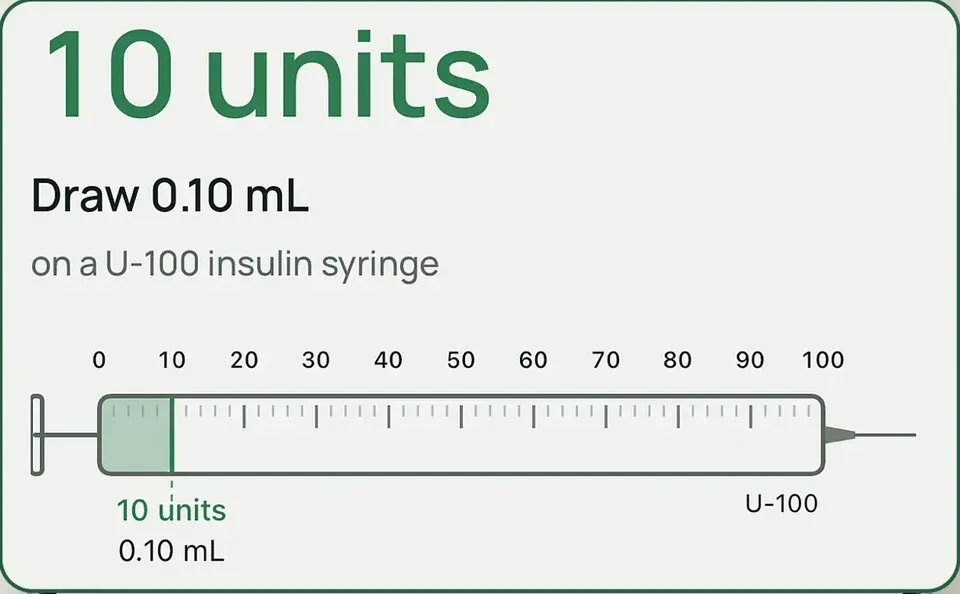
A 10 mg Semaglutide vial mixed with 2 mL of bacteriostatic water holds 5 mg/mL, or 5,000 mcg/mL. On a U-100 syringe 10 units is 0.1 mL, and at this concentration it holds 0.5 mg (500 mcg), one twentieth of the vial. The whole 10 mg is 200 units at 2 mL, more than one 100-unit syringe holds. Mixed with 1 mL instead, the vial is 10 mg/mL and 10 units hold 1 mg; with 3 mL it is 3.33 mg/mL and 10 units hold 0.3333 mg.
Semaglutide label steps converted at the example concentrations used on the GLP-1 pages are tabulated on GLP-1 label steps in units and mL. This section converts the library's 10 mg vial only.
Arithmetic from the example vial size (input) shown, not doses. Water mL is treated as the final volume; a different vial entered in the calculator above gets the same formulas.
Calculator details
About this calculation.
Does this page recommend a Semaglutide dose?
No. The calculator only converts the vial amount, water volume, and dose you enter. It does not provide dosing guidance, diagnosis, or treatment recommendations.
What is the half-life of Semaglutide?
PinPoint's compound library lists Semaglutide with a half-life of 7 days. The app uses this value to estimate levels between logged doses.
How do I use the calculator for Semaglutide?
Enter your vial amount and dose in mg, mcg, IU or mL, and the BAC water you added in mL. The readout shows concentration, draw volume, U-100 syringe units, and doses per vial.
Where does this data come from?
From the compound library inside the PinPoint iOS app. The same values power dose logging and level tracking in the app.
What concentration is Semaglutide at 10 mg in 1 mL?
10 mg divided by 1 mL is 10 mg per mL. That volume spans 100 U-100 syringe units.
How does 2 mL change the concentration of this Semaglutide vial?
10 mg divided by 2 mL is 5 mg per mL, half the concentration in the 1 mL column.
What does the 3 mL column mean for Semaglutide?
10 mg divided by 3 mL is approximately 3.3333 mg per mL. The full 3 mL volume corresponds to 300 U-100 units.
How many units is 0.25 mg of Semaglutide from this vial in 2 mL?
0.25 mg divided by 5 mg per mL is 0.05 mL, or 5 U-100 units.
How many units is the 0.25 mg cited amount of Semaglutide from a 10 mg vial in 2 mL?
The arithmetic is 0.25 mg ÷ 5 mg/mL × 100 = 5 U-100 units (0.05 mL). The amount is cited in Semaglutide prescribing information (2023). Adult label escalation step; first 4 weeks.
From the same library
Related calculators
Keep your protocol together
Track the result in the app.
Set up vials, log doses and sites, and see your next reminder in PinPoint for iOS.

Keep exploring
More tools
- Peptide tracker app Trackers
- GLP-1 tracker app GLP-1
- TRT tracker app Trackers
- Compare trackers Compare
- Peptide calculator Vial, dose and syringe unit math.
- Reconstitution calculator Any powder vial: mg/mL, mL and units.
- BPC-157 TB-500 blend calculator Two peptides in one vial: mg per draw and units.
- KLOW peptide blend calculator KPV, GHK-Cu, BPC-157 and TB-500 in one vial.
- GLOW peptide blend calculator GHK-Cu, BPC-157 and TB-500 in one vial.
- CJC-1295 ipamorelin calculator Two-peptide vial: mcg per draw and units.
- AOD-9604 calculator Reconstitution, concentration and units.
- BPC-157 calculator Reconstitution, concentration and units.
- Cagrilintide calculator Reconstitution, concentration and units.
- CJC-1295 (no DAC) calculator Reconstitution, concentration and units.
- CJC-1295 (with DAC) calculator Reconstitution, concentration and units.
- DSIP calculator Reconstitution, concentration and units.
- GHK-Cu calculator Reconstitution, concentration and units.
- Gonadorelin calculator Reconstitution, concentration and units.
- HCG calculator Reconstitution, concentration and units.
- Hexarelin calculator Reconstitution, concentration and units.
- IGF-1 LR3 calculator Reconstitution, concentration and units.
- Ipamorelin calculator Reconstitution, concentration and units.
- Melanotan II calculator Reconstitution, concentration and units.
- MOTS-c calculator Reconstitution, concentration and units.
- PT-141 calculator Reconstitution, concentration and units.
- Retatrutide calculator Reconstitution, concentration and units.
- Sermorelin calculator Reconstitution, concentration and units.
- TB-500 calculator Reconstitution, concentration and units.
- Tesamorelin calculator Reconstitution, concentration and units.
- Tirzepatide calculator Reconstitution, concentration and units.
- Peptide dosing chart Compare vial concentrations and preset amounts across 21 compound charts.
- Units to mg calculator Convert U-100 syringe units, mg and mL using your own concentration.
- TRT dose calculator Divide weekly mg into amounts and volumes per injection at a known concentration.
- GLP-1 guides GLP-1
- GLP-1 injection sites GLP-1
- GLP-1 doses in units and mL GLP-1
- Tirzepatide dose schedule GLP-1
- Peptide library Guides
- Tirzepatide guide Guides
- Liraglutide guide Guides
- Somatropin guide Guides
- MOTS-c guide Guides
- Retatrutide guide Guides
- Melanotan II guide Guides
- SS-31 guide Guides
- IGF-1 LR3 guide Guides
- Learn explainers Learn
- Retatrutide dosing explained Learn
- IGF-1 LR3 explained Learn
- KLOW peptide blend explained Learn
- MOTS-c dosage explained Learn
- 5-Amino-1MQ explained Learn
- BPC-157 and TB-500 explained Learn
- GHK-Cu dosage explained Learn
- SS-31 and MOTS-c explained Learn
- HGH and somatropin, IU to mg Learn
- Cerebrolysin explained Learn
- Levocarnitine explained Learn
- VIP peptide and aviptadil explained Learn
- Follistatin 344 explained Learn
- Melanotan 1 vs Melanotan 2 Learn
- CagriSema explained Learn
- GHRP-6 vs GHRP-2 compared Learn
Your next chapter starts here
Start Day 1 with
your numbers in place.
Your doses, your schedule, your picture. Bring it together in PinPoint.
Built for iPhone.
Subscription through the App Store, cancel anytime in your Apple ID settings.