Peptide / Unit conversion
Tesamorelin reconstitution calculator
Enter your Tesamorelin vial size, bacteriostatic water volume and dose to calculate concentration and syringe units.
Your inputs determine the result. This calculator does not recommend dosages.
Set your draw.
Enter your vial strength, diluent, and dose to see the draw.
How this is converted
Conversion follows standard mg, mL, and U-100 syringe references.
Performs unit conversions only. Not medical advice. Consult your healthcare provider.
Library reference
Tesamorelin at a glance
Reference values from the PinPoint compound library, not a recommended schedule.
- Category
- Peptide
- Half-life
- 0.15 hours
- Administration routes
- Subcutaneous
- Listed frequencies
- Once daily
The calculation
How the math works
Concentration = vial amount ÷ water mL
Draw volume = dose amount ÷ concentration
U-100 units = draw mL × 100
Units chart
Tesamorelin units chart (mg to U-100 units)
Tesamorelin units chart: mg to U-100 units
Tesamorelin's 2 mg vial amount comes from a prescribing-label source in PinPoint's library. Its description identifies a stabilized GHRH analog, and the peptide record carries an FDA-approved research-status tag. The amount table translates portions of that 2 mg total into volume.
Vial concentration
Water mL is treated as final solution mL in these columns.
| Vial contents | 1 mL water | 2 mL water | 3 mL water |
|---|---|---|---|
| 2 mg | 2 mg/mL50 U-100 units per mg | 1 mg/mL100 U-100 units per mg | 0.6667 mg/mL150 U-100 units per mg |
Vial source: Prescribing label on DailyMed (package presentation), the labeled Tesamorelin package.
Amount to units
Example amounts (arithmetic only, not doses).
| Amount (mg) | 2 mg + 1 mL | 2 mg + 2 mL | 2 mg + 3 mL |
|---|---|---|---|
| 0.04 mg | 2 units | 4 units | 6 units |
| 0.1 mg | 5 units | 10 units | 15 units |
| 0.2 mg | 10 units | 20 units | 30 units |
| 0.4 mg | 20 units | 40 units | 60 units |
| 1 mg | 50 units | 100 units | 150 unitsover one syringe |
Cited amounts
| Amount (mg) and source context | Frequency as stated | Route as stated | 2 mg + 1 mL | 2 mg + 2 mL | 2 mg + 3 mL | Source |
|---|---|---|---|---|---|---|
| 1.4 mgSpecific 2 mg/vial formulation; source preparation is 0.5 mL with a 0.35 mL administration, distinct from these arithmetic columns. | Once daily | Subcutaneous | 70 units | 140 unitsover one syringe | 210 unitsover one syringe | Tesamorelin prescribing informationRegulatory labelRetrieved 2026-10-05 |
How to read this chart
Find the concentration column. Divide the amount by that concentration. Multiply the mL value by 100 for U-100 units. Match the amount units before dividing.
units = amount ÷ (vial mg ÷ water mL) × 100
Amount and volume
One mg equals 1,000 mcg; 100 U-100 units equals 1 mL. Concentration connects amount to volume. Read the full conversion guide.
Nine minutes is an elimination parameter
PinPoint stores 0.15 hours as tesamorelin's half-life, equivalent to nine minutes. The source annotation ties the reference to prescribing-label information. This short value sets the elimination timescale of the base model; it is not a calendar interval for logging. The common-frequency field separately reads Once daily. A timestamp therefore places a short modeled event within a much longer daily record. The app can retain both the day-level sequence and the more detailed clock time without treating those two scales as interchangeable.
Why the peak-time field is a different number
The tesamorelin entry uses a 0.25-hour peak-time parameter, or 15 minutes, alongside a bioavailability coefficient of 0.04, or 4%. The peak input is longer than the stored nine-minute half-life. That arrangement reflects the separate roles of absorption and elimination in the model; a half-life is not a countdown from logging to the peak. These values describe the base compound profile, while an individual log supplies the event's amount and timestamp. None of the three model fields is a concentration in mg per mL.
Subcutaneous context and a label-based package
Subcutaneous is the route listed for tesamorelin, and the library uses a compounded-vial delivery form for its generic record. The package citation specifically documents 2 mg in a single-dose vial. In this collection, that label-based amount stands apart from the many example vial sizes used as inputs. The research-status tag, delivery-form field, and package citation each describe a different aspect of the entry. Reading them together explains why this page uses a 2 mg reference instead of borrowing a larger peptide vial size.
The one-milligram-per-milliliter column
When 2 mg is represented in a final volume of 2 mL, concentration is exactly 1 mg per mL. The tesamorelin example rows of 0.04, 0.1, 0.2, 0.4, and 1 mg then occupy those same numerical amounts in mL. For instance, 0.2 mg becomes 0.2 mL, corresponding to 20 U-100 units. This numerical match belongs to that one concentration. At a 1 mL total volume, the 0.2 mg portion is 0.1 mL; at 3 mL total, it is 0.3 mL.
Units, mL and mg/mL
Tesamorelin dosage in units and mL
Searches for Tesamorelin dosage in units or in mL are conversion questions. Units and mL both measure volume, and what a volume holds depends on how the vial was mixed. The first table gives the concentration of the library's 2 mg Tesamorelin vial at 1, 2 and 3 mL of water; the second shows how many U-100 units each share of the vial takes, and what that share holds. Neither table sets a dose.
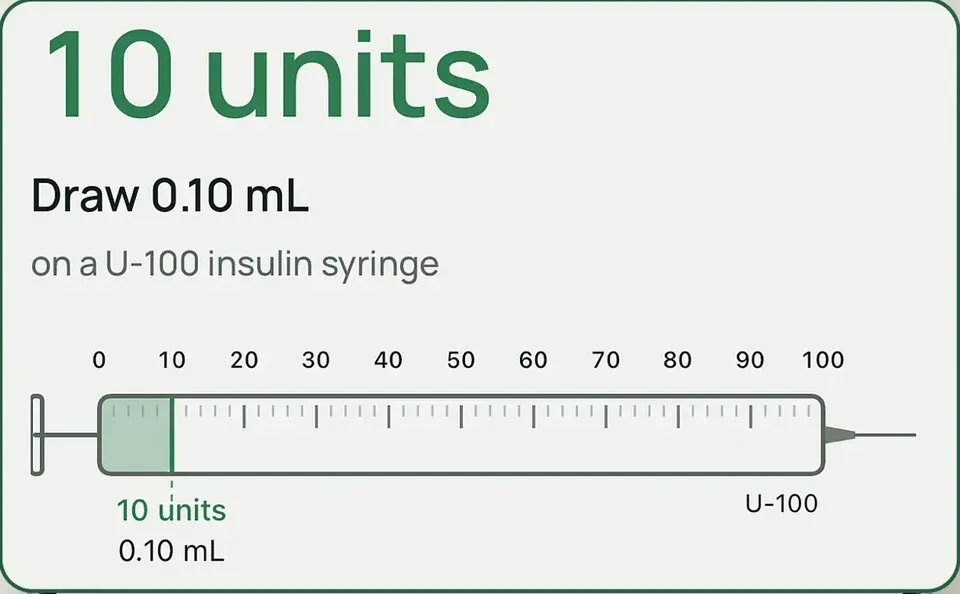
| Water added | Concentration | Units per 1 mg | 10 units (0.1 mL) holds |
|---|---|---|---|
| 1 mL | 2 mg/mL2,000 mcg/mL | 50 units0.5 mL | 0.2 mg200 mcg |
| 2 mL | 1 mg/mL1,000 mcg/mL | 100 units1 mL | 0.1 mg100 mcg |
| 3 mL | 0.67 mg/mL666.67 mcg/mL | 150 units1.5 mL | 0.0667 mg66.7 mcg |
| Fraction of the vial | Holds | Units in 1 mL | Units in 2 mL | Units in 3 mL |
|---|---|---|---|---|
| 1/20 one twentieth | 0.1 mg100 mcg | 5 units 0.05 mL | 10 units 0.1 mL | 15 units 0.15 mL |
| 1/10 one tenth | 0.2 mg200 mcg | 10 units 0.1 mL | 20 units 0.2 mL | 30 units 0.3 mL |
| 1/5 one fifth | 0.4 mg400 mcg | 20 units 0.2 mL | 40 units 0.4 mL | 60 units 0.6 mL |
| 1/4 one quarter | 0.5 mg500 mcg | 25 units 0.25 mL | 50 units 0.5 mL | 75 units 0.75 mL |
| 1/2 one half | 1 mg1,000 mcg | 50 units 0.5 mL | 100 units 1 mL | 150 units 1.5 mL over one 100-unit syringe |
Tesamorelin 2 mg reconstitution: worked example
A 2 mg Tesamorelin vial mixed with 1 mL of bacteriostatic water holds 2 mg/mL, or 2,000 mcg/mL. On a U-100 syringe 10 units is 0.1 mL, and at this concentration it holds 0.2 mg (200 mcg), one tenth of the vial. The whole 2 mg is 100 units at 1 mL. Mixed with 2 mL instead, the vial is 1 mg/mL and 10 units hold 0.1 mg; with 3 mL it is 0.67 mg/mL and 10 units hold 0.0667 mg.
The library has no larger tesamorelin vial, so these tables chart 2 mg; a different label entered in the calculator above gets the same arithmetic. How much bacteriostatic water a vial gets comes from its preparation instructions, and the tables only show what each volume produces.
Arithmetic from the example vial size (input) shown, not doses. Water mL is treated as the final volume; a different vial entered in the calculator above gets the same formulas.
Calculator details
About this calculation.
Does this page recommend a Tesamorelin dose?
No. The calculator only converts the vial amount, water volume, and dose you enter. It does not provide dosing guidance, diagnosis, or treatment recommendations.
What is the half-life of Tesamorelin?
PinPoint's compound library lists Tesamorelin with a half-life of 0.15 hours. The app uses this value to estimate levels between logged doses.
How do I use the calculator for Tesamorelin?
Enter your vial amount and dose in mg, mcg, IU or mL, and the BAC water you added in mL. The readout shows concentration, draw volume, U-100 syringe units, and doses per vial.
Where does this data come from?
From the compound library inside the PinPoint iOS app. The same values power dose logging and level tracking in the app.
What concentration is Tesamorelin at 2 mg in 1 mL?
2 mg divided by 1 mL is 2 mg per mL. That volume spans 100 U-100 syringe units.
How does 2 mL change the concentration of this Tesamorelin vial?
2 mg divided by 2 mL is 1 mg per mL, half the concentration in the 1 mL column.
What does the 3 mL column mean for Tesamorelin?
2 mg divided by 3 mL is approximately 0.6667 mg per mL. The full 3 mL volume corresponds to 300 U-100 units.
How many units is 0.2 mg of Tesamorelin from this vial in 2 mL?
0.2 mg divided by 1 mg per mL is 0.2 mL, or 20 U-100 units.
How many units is the 1.4 mg cited amount of Tesamorelin from a 2 mg vial in 2 mL?
The arithmetic is 1.4 mg ÷ 1 mg/mL × 100 = 140 U-100 units (1.4 mL). The amount is cited in Tesamorelin prescribing information. Specific 2 mg/vial formulation; source preparation is 0.5 mL with a 0.35 mL administration, distinct from these arithmetic columns. This exceeds one 1 mL syringe.
From the same library
Related calculators
Keep your protocol together
Track the result in the app.
Set up vials, log doses and sites, and see your next reminder in PinPoint for iOS.

Keep exploring
More tools
- Peptide tracker app Trackers
- GLP-1 tracker app GLP-1
- TRT tracker app Trackers
- Compare trackers Compare
- Peptide calculator Vial, dose and syringe unit math.
- Reconstitution calculator Any powder vial: mg/mL, mL and units.
- BPC-157 TB-500 blend calculator Two peptides in one vial: mg per draw and units.
- KLOW peptide blend calculator KPV, GHK-Cu, BPC-157 and TB-500 in one vial.
- GLOW peptide blend calculator GHK-Cu, BPC-157 and TB-500 in one vial.
- CJC-1295 ipamorelin calculator Two-peptide vial: mcg per draw and units.
- AOD-9604 calculator Reconstitution, concentration and units.
- BPC-157 calculator Reconstitution, concentration and units.
- Cagrilintide calculator Reconstitution, concentration and units.
- CJC-1295 (no DAC) calculator Reconstitution, concentration and units.
- CJC-1295 (with DAC) calculator Reconstitution, concentration and units.
- DSIP calculator Reconstitution, concentration and units.
- GHK-Cu calculator Reconstitution, concentration and units.
- Gonadorelin calculator Reconstitution, concentration and units.
- HCG calculator Reconstitution, concentration and units.
- Hexarelin calculator Reconstitution, concentration and units.
- IGF-1 LR3 calculator Reconstitution, concentration and units.
- Ipamorelin calculator Reconstitution, concentration and units.
- Melanotan II calculator Reconstitution, concentration and units.
- MOTS-c calculator Reconstitution, concentration and units.
- PT-141 calculator Reconstitution, concentration and units.
- Retatrutide calculator Reconstitution, concentration and units.
- Semaglutide calculator Reconstitution, concentration and units.
- Sermorelin calculator Reconstitution, concentration and units.
- TB-500 calculator Reconstitution, concentration and units.
- Tirzepatide calculator Reconstitution, concentration and units.
- Peptide dosing chart Compare vial concentrations and preset amounts across 21 compound charts.
- Units to mg calculator Convert U-100 syringe units, mg and mL using your own concentration.
- TRT dose calculator Divide weekly mg into amounts and volumes per injection at a known concentration.
- GLP-1 guides GLP-1
- GLP-1 injection sites GLP-1
- GLP-1 doses in units and mL GLP-1
- Tirzepatide dose schedule GLP-1
- Peptide library Guides
- Tirzepatide guide Guides
- Liraglutide guide Guides
- Somatropin guide Guides
- MOTS-c guide Guides
- Retatrutide guide Guides
- Melanotan II guide Guides
- SS-31 guide Guides
- IGF-1 LR3 guide Guides
- Learn explainers Learn
- Retatrutide dosing explained Learn
- IGF-1 LR3 explained Learn
- KLOW peptide blend explained Learn
- MOTS-c dosage explained Learn
- 5-Amino-1MQ explained Learn
- BPC-157 and TB-500 explained Learn
- GHK-Cu dosage explained Learn
- SS-31 and MOTS-c explained Learn
- HGH and somatropin, IU to mg Learn
- Cerebrolysin explained Learn
- Levocarnitine explained Learn
- VIP peptide and aviptadil explained Learn
- Follistatin 344 explained Learn
- Melanotan 1 vs Melanotan 2 Learn
- CagriSema explained Learn
- GHRP-6 vs GHRP-2 compared Learn
Your next chapter starts here
Start Day 1 with
your numbers in place.
Your doses, your schedule, your picture. Bring it together in PinPoint.
Built for iPhone.
Subscription through the App Store, cancel anytime in your Apple ID settings.