Any powder vial / Unit conversion
Reconstitution calculator
Enter the concentration of a mixed vial and an amount to see the draw in mL and U-100 syringe units. Have a powder vial instead? Switch the mode to Reconstitution and enter the powder amount and the diluent volume.
Conversion only. This calculator does not recommend a dose, a diluent or a volume.
Set your draw.
Enter your vial strength, diluent, and dose to see the draw.
How this is converted
Conversion follows standard mg, mL, and U-100 syringe references.
Performs unit conversions only. Not medical advice. Consult your healthcare provider.
The method
The three numbers in every reconstitution
Concentration = powder mg ÷ diluent mL
Draw volume = amount ÷ concentration
U-100 units = draw mL × 100
Reconstitution turns a powder into a liquid that can be measured. Whatever the vial holds, whether a research peptide, HCG, a growth hormone product or a laboratory reagent, the arithmetic uses three numbers: the amount of powder on the label, the volume of diluent in the vial, and the concentration that results.
The first two come from the label and the bottle. The third is the one that matters afterwards, because every later measurement is a volume of that liquid. A 5 mg vial mixed with 2 mL holds 2.5 mg/mL; the same vial mixed with 5 mL holds 1 mg/mL. Neither figure is better than the other. They describe two different liquids, and the calculator needs to know which one is in the vial.
People search for a medication reconstitution calculator, a peptide calculator in mg or a dilution calculator for mg/mL, and all three are this same arithmetic. The calculation treats the diluent volume as the final volume, as the charts on this site do. When a label or a pharmacist states a final concentration, enter that concentration directly; it takes priority over the arithmetic.
Two ways in
Concentration mode and Reconstitution mode
The calculator opens in Concentration mode, for a liquid whose mg/mL is already known: a mixed vial, a pharmacy label or a figure worked out earlier. Enter the mg/mL and an amount, and it returns the draw volume and the units.
Reconstitution mode works one step earlier. It takes the powder amount and the diluent volume, works out the concentration itself, then converts the amount to a draw. Both modes give the same draw for the same liquid: a 10 mg vial in 2 mL entered as a vial, and 5 mg/mL entered directly, both put 0.25 mg at 5 units.
Syringe scale
How a U-100 syringe maps mL to units
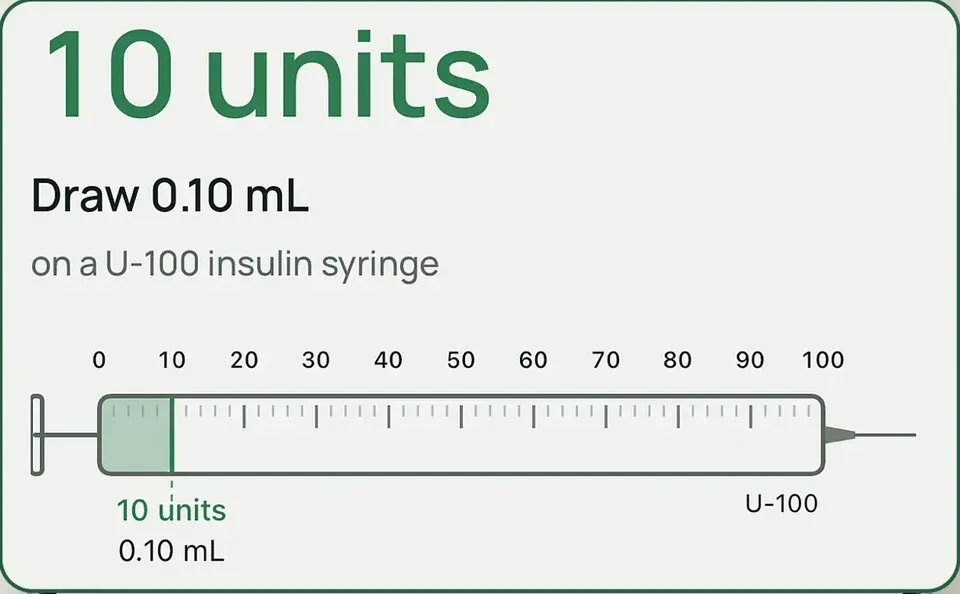
Insulin-style syringes are marked in units, and on the U-100 scale 100 units is 1 mL. Each unit is therefore 0.01 mL, and a draw volume converts to units by multiplying it by 100.
The three sizes the calculator offers follow the same scale: a 30-unit syringe holds 0.3 mL, a 50-unit syringe holds 0.5 mL and a 100-unit syringe holds 1 mL. A draw larger than the chosen syringe is flagged in the readout.
Units count volume, not amount. Ten units is 0.1 mL in every vial; what those 10 units contain depends on the concentration. At 2.5 mg/mL they hold 0.25 mg, and at 5 mg/mL they hold 0.5 mg. HCG and some growth hormone labels state IU instead of mg; IU is a measure of amount too, and it is a different thing from syringe units.
Label size × diluent volume
Reconstitution chart: mg/mL and units per mg
The chart lists 2, 5 and 10 mg labels against 1, 2, 3 and 5 mL of diluent. Each cell shows the concentration and how many U-100 units one milligram occupies at that concentration. A value above 100 units per mg means one milligram is more liquid than a 1 mL syringe holds.
| Label amount | 1 mL diluent | 2 mL diluent | 3 mL diluent | 5 mL diluent |
|---|---|---|---|---|
| 2 mg | 2 mg/mL 50 units per mg | 1 mg/mL 100 units per mg | 0.67 mg/mL 150 units per mg 1 mg is over one 1 mL syringe | 0.4 mg/mL 250 units per mg 1 mg is over one 1 mL syringe |
| 5 mg | 5 mg/mL 20 units per mg | 2.5 mg/mL 40 units per mg | 1.67 mg/mL 60 units per mg | 1 mg/mL 100 units per mg |
| 10 mg | 10 mg/mL 10 units per mg | 5 mg/mL 20 units per mg | 3.33 mg/mL 30 units per mg | 2 mg/mL 50 units per mg |
To read another amount, scale the units per mg. At 2 mg/mL one milligram is 50 units, so 0.25 mg is 12.5 units. Doubling the diluent halves every concentration and doubles every unit count, which is why the 1 mL and 2 mL columns differ by exactly a factor of two.
Arithmetic from the label amounts shown, not doses. Diluent mL is treated as the final volume.
Same rule, other direction
Using it as a dilution calculator for mg/mL
A dilution calculator for mg/mL answers the same question from the other side: how concentrated is the liquid once a given volume is in the vial. The amount of powder never changes; only the volume does. More diluent gives a lower mg/mL and more units for any amount, less diluent gives a higher mg/mL and fewer units, and the syringe marks have to be read against whichever liquid is actually in the vial.
The rule holds for labels in IU. HCG at 5,000 IU in 2 mL is 2,500 IU/mL. The calculator accepts IU for the vial and for the amount, and it converts between IU and mg only for compounds whose library entry lists a factor. For somatropin, the HGH IU to mg explainer works that conversion from the label's own IU per mg figure. The peptide calculator does the same arithmetic with the compound library loaded for names and label references.
Calculator details
Reconstitution questions.
What does a reconstitution calculator do?
It divides the powder amount by the diluent volume to get a concentration, then converts an amount into a draw volume in mL and U-100 syringe units. It works for any vial labelled in mg, mcg or IU.
Does it recommend how much diluent to add?
No. The diluent volume is your input. The calculator shows what concentration a volume produces; it does not choose a volume, a dose or a mixing method.
How do I calculate mg/mL after reconstitution?
Divide the milligrams on the label by the milliliters of diluent. A 10 mg vial with 2 mL is 5 mg/mL; with 3 mL it is about 3.33 mg/mL.
How many units is 1 mL on an insulin syringe?
On a U-100 syringe, 100 units is 1 mL, so 1 unit is 0.01 mL. A 30-unit syringe holds 0.3 mL and a 50-unit syringe holds 0.5 mL.
Can I use it for HCG or HGH in IU?
Yes. Enter the vial and the amount in IU and the calculator returns IU per mL, the draw volume and units. Converting between IU and mg needs a compound whose library entry lists a factor.
Read next
Before you mix: the guides
This page does arithmetic only. The how to reconstitute peptides guide walks through the numbers step by step, and bacteriostatic water vs sterile water explains the two diluents. For unit conversions without a vial in the picture, the units to mg converter converts syringe units, mL and mg at a known concentration.
From calculation to routine
Track the result in the app.
Set up each vial once, log doses and sites, and keep your schedule together in PinPoint for iOS.

Keep exploring
More tools
- Compound half-lives Learn
- Peptide tracker app Trackers
- GLP-1 tracker app Trackers
- TRT tracker app Trackers
- Compare trackers Compare
- Peptide calculator Vial, dose and syringe unit math.
- BPC-157 TB-500 blend calculator Two peptides in one vial: mg per draw and units.
- KLOW peptide blend calculator KPV, GHK-Cu, BPC-157 and TB-500 in one vial.
- GLOW peptide blend calculator GHK-Cu, BPC-157 and TB-500 in one vial.
- CJC-1295 ipamorelin calculator Two-peptide vial: mcg per draw and units.
- AOD-9604 calculator Reconstitution, concentration and units.
- BPC-157 calculator Reconstitution, concentration and units.
- Cagrilintide calculator Reconstitution, concentration and units.
- CJC-1295 (no DAC) calculator Reconstitution, concentration and units.
- CJC-1295 (with DAC) calculator Reconstitution, concentration and units.
- DSIP calculator Reconstitution, concentration and units.
- GHK-Cu calculator Reconstitution, concentration and units.
- Gonadorelin calculator Reconstitution, concentration and units.
- HCG calculator Reconstitution, concentration and units.
- Hexarelin calculator Reconstitution, concentration and units.
- IGF-1 LR3 calculator Reconstitution, concentration and units.
- Ipamorelin calculator Reconstitution, concentration and units.
- Melanotan II calculator Reconstitution, concentration and units.
- MOTS-c calculator Reconstitution, concentration and units.
- PT-141 calculator Reconstitution, concentration and units.
- Retatrutide calculator Reconstitution, concentration and units.
- Semaglutide calculator Reconstitution, concentration and units.
- Sermorelin calculator Reconstitution, concentration and units.
- TB-500 calculator Reconstitution, concentration and units.
- Tesamorelin calculator Reconstitution, concentration and units.
- Tirzepatide calculator Reconstitution, concentration and units.
- Peptide dosing chart Compare vial concentrations and preset amounts across 21 compound charts.
- Units to mg calculator Convert U-100 syringe units, mg and mL using your own concentration.
- TRT dose calculator Divide weekly mg into amounts and volumes per injection at a known concentration.
- Semaglutide dosing chart Convert Semaglutide mg amounts to volume with a printable concentration chart.
- Tirzepatide dosing chart Convert Tirzepatide mg amounts to volume with a printable concentration chart.
- BPC-157 dosing chart Convert BPC-157 mg amounts to volume with a printable concentration chart.
- TB-500 dosing chart Convert TB-500 mg amounts to volume with a printable concentration chart.
- Ipamorelin dosing chart Convert Ipamorelin mg amounts to volume with a printable concentration chart.
- CJC-1295 (no DAC) dosing chart Convert CJC-1295 (no DAC) mg amounts to volume with a printable concentration chart.
- CJC-1295 (with DAC) dosing chart Convert CJC-1295 (with DAC) mg amounts to volume with a printable concentration chart.
- HCG dosing chart Convert HCG IU amounts to volume with a printable concentration chart.
- Retatrutide dosing chart Convert Retatrutide mg amounts to volume with a printable concentration chart.
- Cagrilintide dosing chart Convert Cagrilintide mg amounts to volume with a printable concentration chart.
- GHK-Cu dosing chart Convert GHK-Cu mg amounts to volume with a printable concentration chart.
- PT-141 dosing chart Convert PT-141 mg amounts to volume with a printable concentration chart.
- Melanotan II dosing chart Convert Melanotan II mg amounts to volume with a printable concentration chart.
- Sermorelin dosing chart Convert Sermorelin mg amounts to volume with a printable concentration chart.
- Tesamorelin dosing chart Convert Tesamorelin mg amounts to volume with a printable concentration chart.
- Hexarelin dosing chart Convert Hexarelin mg amounts to volume with a printable concentration chart.
- AOD-9604 dosing chart Convert AOD-9604 mg amounts to volume with a printable concentration chart.
- MOTS-c dosing chart Convert MOTS-c mg amounts to volume with a printable concentration chart.
- IGF-1 LR3 dosing chart Convert IGF-1 LR3 mg amounts to volume with a printable concentration chart.
- DSIP dosing chart Convert DSIP mg amounts to volume with a printable concentration chart.
- Gonadorelin dosing chart Convert Gonadorelin mg amounts to volume with a printable concentration chart.
- NAD+ dosing chart Convert a 500 mg NAD+ vial into mg per mL and U-100 units by volume.
- GLP-1 guides GLP-1
- Zepbound tracker GLP-1
- Mounjaro tracker GLP-1
- Ozempic tracker GLP-1
- Wegovy tracker GLP-1
- Peptide library Guides
- Tirzepatide guide Guides
- Liraglutide guide Guides
- Somatropin guide Guides
- MOTS-c guide Guides
- Retatrutide guide Guides
- Melanotan II guide Guides
- SS-31 guide Guides
- IGF-1 LR3 guide Guides
- Learn explainers Learn
- Retatrutide dosing explained Learn
- IGF-1 LR3 explained Learn
- KLOW peptide blend explained Learn
- MOTS-c dosage explained Learn
- 5-Amino-1MQ explained Learn
- BPC-157 and TB-500 explained Learn
- GHK-Cu dosage explained Learn
- SS-31 and MOTS-c explained Learn
- HGH and somatropin, IU to mg Learn
- Cerebrolysin explained Learn
- Levocarnitine explained Learn
- VIP peptide and aviptadil explained Learn
- Follistatin 344 explained Learn
- Melanotan 1 vs Melanotan 2 Learn
- CagriSema explained Learn
- GHRP-6 vs GHRP-2 compared Learn