Peptide / Unit conversion
PT-141 reconstitution calculator
Enter your PT-141 vial size, bacteriostatic water volume and dose to calculate concentration and syringe units.
Your inputs determine the result. This calculator does not recommend dosages.
Set your draw.
Enter your vial strength, diluent, and dose to see the draw.
How this is converted
Conversion follows standard mg, mL, and U-100 syringe references.
Performs unit conversions only. Not medical advice. Consult your healthcare provider.
Library reference
PT-141 at a glance
Reference values from the PinPoint compound library, not a recommended schedule.
- Category
- Peptide
- Half-life
- 2.5 hours
- Administration routes
- Subcutaneous
- Listed frequencies
- As needed, Not more than once in 24h
The calculation
How the math works
Concentration = vial amount ÷ water mL
Draw volume = dose amount ÷ concentration
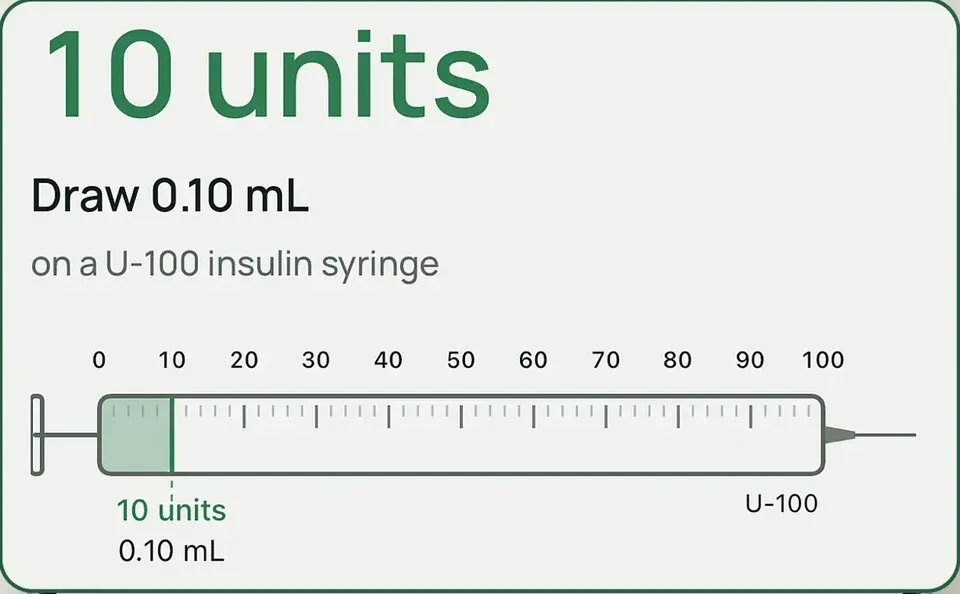
U-100 units = draw mL × 100
Units chart
PT-141 units chart (mg to U-100 units)
PT-141 units chart: mg to U-100 units
PT-141 appears in PinPoint as the generic compound bremelanotide, described in the library as a melanocortin receptor agonist. Its peptide entry has an FDA-approved status tag and a 10 mg example vial. Five vial fractions provide the amount-to-units comparisons here.
Vial concentration
Water mL is treated as final solution mL in these columns.
| Vial contents | 1 mL water | 2 mL water | 3 mL water |
|---|---|---|---|
| 10 mg | 10 mg/mL10 U-100 units per mg | 5 mg/mL20 U-100 units per mg | 3.3333 mg/mL30 U-100 units per mg |
Example vial size (input): 10 mg. No package source is cited; the size is an arithmetic input, not a sourced fact.
Amount to units
Example amounts (arithmetic only, not doses).
| Amount (mg) | 10 mg + 1 mL | 10 mg + 2 mL | 10 mg + 3 mL |
|---|---|---|---|
| 0.2 mg | 2 units | 4 units | 6 units |
| 0.5 mg | 5 units | 10 units | 15 units |
| 1 mg | 10 units | 20 units | 30 units |
| 2 mg | 20 units | 40 units | 60 units |
| 5 mg | 50 units | 100 units | 150 unitsover one syringe |
Cited amounts
| Amount (mg) and source context | Frequency as stated | Route as stated | 10 mg + 1 mL | 10 mg + 2 mL | 10 mg + 3 mL | Source |
|---|---|---|---|---|---|---|
| 0.75 mg2017 blood-pressure study in premenopausal women. | Two administrations separated by 24 hours | Subcutaneous | 7.5 units | 15 units | 22.5 units | Bremelanotide blood-pressure study, Journal of Hypertension (2017)Peer-reviewed studyRetrieved 2026-10-05 |
| 1.25 mg2017 blood-pressure study in premenopausal women. | Two administrations separated by 24 hours | Subcutaneous | 12.5 units | 25 units | 37.5 units | Bremelanotide blood-pressure study, Journal of Hypertension (2017)Peer-reviewed studyRetrieved 2026-10-05 |
| 1.75 mgLabel amount for premenopausal women with acquired, generalized HSDD. | As needed, at least 45 minutes before sexual activity; at most once per 24 hours and 8 times monthly | Subcutaneous | 17.5 units | 35 units | 52.5 units | Bremelanotide prescribing informationRegulatory labelRetrieved 2026-10-05 |
How to read this chart
Find the concentration column. Divide the amount by that concentration. Multiply the mL value by 100 for U-100 units. Match the amount units before dividing.
units = amount ÷ (vial mg ÷ water mL) × 100
Amount and volume
One mg equals 1,000 mcg; 100 U-100 units equals 1 mL. Concentration connects amount to volume. Read the full conversion guide.
The stored value and its source annotation
The PT-141 half-life used by the library is 2.5 hours. Its prescribing-label source annotation also mentions an approximately 2.7-hour terminal half-life. This page reports the stored 2.5-hour model input rather than silently replacing it with the nearby reference number. Keeping that distinction visible makes the profile traceable to the app. Either duration is expressed in hours, whereas the volume table is independent of elapsed time: a 10 mg vial divided by 2 mL remains 5 mg per mL throughout the calculation.
Peak timing in an event log
PinPoint records a one-hour time-to-peak parameter and a base bioavailability coefficient of 0.85 for PT-141. That coefficient is 85% when displayed as a percentage. The administration-route list contains subcutaneous, paired with a compounded-vial delivery form. The event's timestamp is what places the modeled rise on the log's timeline. An amount recorded at one clock time and the same amount recorded hours later produce differently positioned estimates even though their concentration and syringe-volume arithmetic can be identical.
Frequency text without a repeating weekly pattern
The PT-141 common-frequency field contains the labels As needed and Not more than once in 24h. Those are the library's stored descriptions, rather than a single recurring weekday interval. This makes the actual sequence of logged timestamps especially useful when reviewing the record. PinPoint's model has its own hour-based parameters regardless of how entries are spaced on the calendar. The chart does not infer a weekly total from those labels; it presents individual mg amounts and their corresponding liquid volumes.
An example vial expressed in portions
The 10 mg figure is an example vial size (input) for a lyophilized PT-141 vial. Its example rows are 0.2, 0.5, 1, 2, and 5 mg. Consider the 1 mg portion: it is a tenth of the vial's contents, so its volume is a tenth of each column's solution volume. That gives 0.1, 0.2, and 0.3 mL, or 10, 20, and 30 U-100 units. The half-vial row of 5 mg follows the same relationship but reaches 1.5 mL in the final column.
Calculator details
About this calculation.
Does this page recommend a PT-141 dose?
No. The calculator only converts the vial amount, water volume, and dose you enter. It does not provide dosing guidance, diagnosis, or treatment recommendations.
What is the half-life of PT-141?
PinPoint's compound library lists PT-141 with a half-life of 2.5 hours. The app uses this value to estimate levels between logged doses.
How do I use the calculator for PT-141?
Enter your vial amount and dose in mg, mcg, IU or mL, and the BAC water you added in mL. The readout shows concentration, draw volume, U-100 syringe units, and doses per vial.
Where does this data come from?
From the compound library inside the PinPoint iOS app. The same values power dose logging and level tracking in the app.
What concentration is PT-141 at 10 mg in 1 mL?
10 mg divided by 1 mL is 10 mg per mL. That volume spans 100 U-100 syringe units.
How does 2 mL change the concentration of this PT-141 vial?
10 mg divided by 2 mL is 5 mg per mL, half the concentration in the 1 mL column.
What does the 3 mL column mean for PT-141?
10 mg divided by 3 mL is approximately 3.3333 mg per mL. The full 3 mL volume corresponds to 300 U-100 units.
How many units is 1 mg of PT-141 from this vial in 2 mL?
1 mg divided by 5 mg per mL is 0.2 mL, or 20 U-100 units.
How many units is the 0.75 mg cited amount of PT-141 from a 10 mg vial in 2 mL?
The arithmetic is 0.75 mg ÷ 5 mg/mL × 100 = 15 U-100 units (0.15 mL). The amount is cited in Bremelanotide blood-pressure study, Journal of Hypertension (2017). 2017 blood-pressure study in premenopausal women.
From the same library
Related calculators
Keep your protocol together
Track the result in the app.
Set up vials, log doses and sites, and see your next reminder in PinPoint for iOS.

Keep exploring
More tools
- Peptide tracker app Trackers
- GLP-1 tracker app GLP-1
- TRT tracker app Trackers
- Compare trackers Compare
- Peptide calculator Vial, dose and syringe unit math.
- Reconstitution calculator Any powder vial: mg/mL, mL and units.
- BPC-157 TB-500 blend calculator Two peptides in one vial: mg per draw and units.
- KLOW peptide blend calculator KPV, GHK-Cu, BPC-157 and TB-500 in one vial.
- GLOW peptide blend calculator GHK-Cu, BPC-157 and TB-500 in one vial.
- CJC-1295 ipamorelin calculator Two-peptide vial: mcg per draw and units.
- AOD-9604 calculator Reconstitution, concentration and units.
- BPC-157 calculator Reconstitution, concentration and units.
- Cagrilintide calculator Reconstitution, concentration and units.
- CJC-1295 (no DAC) calculator Reconstitution, concentration and units.
- CJC-1295 (with DAC) calculator Reconstitution, concentration and units.
- DSIP calculator Reconstitution, concentration and units.
- GHK-Cu calculator Reconstitution, concentration and units.
- Gonadorelin calculator Reconstitution, concentration and units.
- HCG calculator Reconstitution, concentration and units.
- Hexarelin calculator Reconstitution, concentration and units.
- IGF-1 LR3 calculator Reconstitution, concentration and units.
- Ipamorelin calculator Reconstitution, concentration and units.
- Melanotan II calculator Reconstitution, concentration and units.
- MOTS-c calculator Reconstitution, concentration and units.
- Retatrutide calculator Reconstitution, concentration and units.
- Semaglutide calculator Reconstitution, concentration and units.
- Sermorelin calculator Reconstitution, concentration and units.
- TB-500 calculator Reconstitution, concentration and units.
- Tesamorelin calculator Reconstitution, concentration and units.
- Tirzepatide calculator Reconstitution, concentration and units.
- Peptide dosing chart Compare vial concentrations and preset amounts across 21 compound charts.
- Units to mg calculator Convert U-100 syringe units, mg and mL using your own concentration.
- TRT dose calculator Divide weekly mg into amounts and volumes per injection at a known concentration.
- GLP-1 guides GLP-1
- GLP-1 injection sites GLP-1
- GLP-1 doses in units and mL GLP-1
- Tirzepatide dose schedule GLP-1
- Peptide library Guides
- Tirzepatide guide Guides
- Liraglutide guide Guides
- Somatropin guide Guides
- MOTS-c guide Guides
- Retatrutide guide Guides
- Melanotan II guide Guides
- SS-31 guide Guides
- IGF-1 LR3 guide Guides
- Learn explainers Learn
- Retatrutide dosing explained Learn
- IGF-1 LR3 explained Learn
- KLOW peptide blend explained Learn
- MOTS-c dosage explained Learn
- 5-Amino-1MQ explained Learn
- BPC-157 and TB-500 explained Learn
- GHK-Cu dosage explained Learn
- SS-31 and MOTS-c explained Learn
- HGH and somatropin, IU to mg Learn
- Cerebrolysin explained Learn
- Levocarnitine explained Learn
- VIP peptide and aviptadil explained Learn
- Follistatin 344 explained Learn
- Melanotan 1 vs Melanotan 2 Learn
- CagriSema explained Learn
- GHRP-6 vs GHRP-2 compared Learn
Your next chapter starts here
Start Day 1 with
your numbers in place.
Your doses, your schedule, your picture. Bring it together in PinPoint.
Built for iPhone.
Subscription through the App Store, cancel anytime in your Apple ID settings.