Blend / Unit conversion
BPC-157 TB-500 blend dosage calculator
A BPC-157 TB-500 blend is one vial with two label amounts and one liquid volume. Enter both amounts, the bacteriostatic water and a draw, and the calculator shows the milligrams of each peptide in that draw and the U-100 syringe units.
The rows open with the library's package examples (BPC-157 5 mg, TB-500 10 mg). Replace them with your vial's label. This calculator converts your inputs and does not recommend dosages.
Set your draw.
Enter your vial strength, diluent, and dose to see the draw.
How this is converted
Conversion follows standard mg, mL, and U-100 syringe references.
Performs unit conversions only. Not medical advice. Consult your healthcare provider.
One vial, several amounts
What is a BPC-157 TB-500 blend?
Some vendors sell BPC-157 and TB-500 as one powder vial instead of two. The label prints two amounts, usually a smaller figure for BPC-157 and a larger one for TB-500, and the vial is mixed once with one volume of bacteriostatic water. After mixing there is a single liquid, and every drop of it carries both peptides in the proportion the label sets.
That is the whole difference between a blend and two separate vials. With separate vials, each draw is set on its own. With a blend, a draw is a share of the vial, and the share is the same for both components: one twentieth of the liquid delivers one twentieth of the BPC-157 and one twentieth of the TB-500. No draw can change one amount without changing the other.
This page does not suggest an amount of either peptide. No source in PinPoint's library studied the pair, and the BPC-157 and TB-500 stack guide describes each compound from its own evidence. What the page does is the unit conversion: label amounts and water in; concentration, milligrams per draw and syringe units out.
Units per fraction of the vial
BPC-157 TB-500 blend dosage calculator: printable chart
BPC-157 TB-500 blend chart: units per fraction of the vial
The chart answers the question most blend searches are asking: how many units on a U-100 syringe is a given share of the vial, and what does that share hold. Rows are fractions of the vial. The unit columns depend only on the final volume, so they read the same for any label. The milligram columns use the library's package examples, 5 mg of BPC-157 and 10 mg of TB-500, the same figures the stack guide converts. They are examples, not a blend label; for a different label, use the second table or enter your label in the calculator above.
| Fraction of the vial | Units in 1 mL | Units in 2 mL | Units in 3 mL | BPC-157 (5 mg label) | TB-500 (10 mg label) |
|---|---|---|---|---|---|
| 1/20 one twentieth | 5 units 0.05 mL | 10 units 0.1 mL | 15 units 0.15 mL | 0.25 mg 250 mcg | 0.5 mg 500 mcg |
| 1/10 one tenth | 10 units 0.1 mL | 20 units 0.2 mL | 30 units 0.3 mL | 0.5 mg 500 mcg | 1 mg 1,000 mcg |
| 1/5 one fifth | 20 units 0.2 mL | 40 units 0.4 mL | 60 units 0.6 mL | 1 mg 1,000 mcg | 2 mg 2,000 mcg |
| 1/4 one quarter | 25 units 0.25 mL | 50 units 0.5 mL | 75 units 0.75 mL | 1.25 mg 1,250 mcg | 2.5 mg 2,500 mcg |
| 1/2 one half | 50 units 0.5 mL | 100 units 1 mL | 150 units 1.5 mL over one syringe | 2.5 mg 2,500 mcg | 5 mg 5,000 mcg |
| Fraction of the vial | Units in 1 mL | Units in 2 mL | Units in 3 mL | Per 1 mg on the label |
|---|---|---|---|---|
| 1/20 one twentieth | 5 units | 10 units | 15 units | 0.05 mg 50 mcg |
| 1/10 one tenth | 10 units | 20 units | 30 units | 0.1 mg 100 mcg |
| 1/5 one fifth | 20 units | 40 units | 60 units | 0.2 mg 200 mcg |
| 1/4 one quarter | 25 units | 50 units | 75 units | 0.25 mg 250 mcg |
| 1/2 one half | 50 units | 100 units | 150 units over one syringe | 0.5 mg 500 mcg |
Read a row from left to right. One tenth of a vial mixed with 2 mL is 20 units, and with the example label it holds 0.5 mg of BPC-157 and 1 mg of TB-500. A cell marked over one syringe is more liquid than a 100-unit syringe holds; it describes the arithmetic, not a single draw.
The print view keeps both tables and these reading notes on one sheet and leaves out the calculator, navigation and the longer text. Choosing Save as PDF in the browser's print dialog gives a BPC-157 TB-500 blend chart PDF with the same numbers.
Fractions, volumes and amounts are arithmetic from the label figures shown, not doses. Water mL is treated as the final volume, and 100 U-100 units equal 1 mL.
The calculation
How the math works
Example: the label rows above, mixed to 2 mL, with a draw of 10 units.
Each component = label amount ÷ final mL
Draw volume = units ÷ 100, or the amount ÷ that component's concentration
In the draw = draw mL × each concentration
BPC-157: 5 mg ÷ 2 mL = 2.5 mg/mL
TB-500: 10 mg ÷ 2 mL = 5 mg/mL
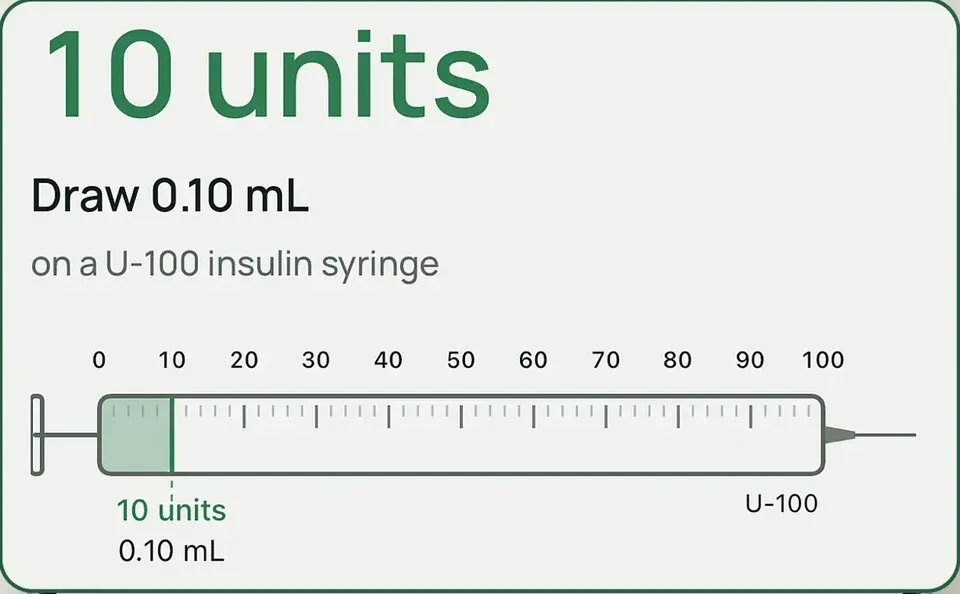
10 u ÷ 100 u/mL = 0.10 mL
0.10 mL ÷ 2 mL = 5% of the vial
BPC-157: 0.10 mL × 2.5 mg/mL = 0.25 mg
TB-500: 0.10 mL × 5 mg/mL = 0.5 mg
0.10 mL × 100 u/mL = 10 u
Each component gets its own concentration: its label milligrams divided by the final volume in mL. BPC-157 at 5 mg in 2 mL is 2.5 mg/mL; TB-500 at 10 mg in the same 2 mL is 5 mg/mL. The two numbers differ because the label amounts differ, not because the liquid does.
A draw is a volume. On a U-100 syringe 100 units is 1 mL, so 10 units is 0.1 mL. That volume is 5% of the 2 mL in the vial, and it carries 5% of each label amount: 0.25 mg (250 mcg) of BPC-157 and 0.5 mg (500 mcg) of TB-500.
Doses per vial come from the same share. If each draw is one twentieth of the liquid, the vial holds 20 such draws, and both components run out on the same draw. When a draw is entered as an amount of one component, the calculator first converts it to a volume through that component's concentration and then reads the other component from the same volume.
Changing the water changes every concentration together. In 1 mL the same label is 5 mg/mL of BPC-157 and 10 mg/mL of TB-500, and 10 units then holds 0.5 mg and 1 mg. The share of the vial in a given row does not change with the water; only the number of units that represents it does.
Why one blend cannot be adjusted for one peptide
Because both peptides share one liquid, the proportion between them is fixed by the label. A larger draw raises both amounts and a smaller one lowers both. Setting BPC-157 and TB-500 separately needs separate vials, and the BPC-157 calculator and TB-500 calculator handle one vial each.
PinPoint's library lists BPC-157 and TB-500 as two compounds and has no blend entry. A draw from a blend vial can still be recorded by hand as two entries, one per compound, each with the milligrams this calculator shows. Kept that way, the history shows each compound's total and its own modeled curve, instead of one line that hides both.
Calculator details
About this blend calculation.
Does this calculator recommend a BPC-157 TB-500 blend dose?
No. It converts the label amounts, water volume and draw you enter. It does not suggest an amount, a schedule or a mixing proportion for either peptide.
How many units is one twentieth of a BPC-157 TB-500 blend vial?
It depends only on the final volume: 5 units in 1 mL, 10 units in 2 mL and 15 units in 3 mL. With the 5 mg and 10 mg example label, that draw holds 0.25 mg of BPC-157 and 0.5 mg of TB-500.
How do I find the mg of each peptide in my draw?
Divide each label amount by the final mL to get its concentration, then multiply by the draw in mL. On a U-100 syringe, units divided by 100 gives mL. The calculator does both steps for every component at once.
Can I enter the draw as micrograms of BPC-157?
Yes. Choose mcg or mg as the draw unit and pick BPC-157 in the Amount of menu. The calculator turns that amount into a volume through the BPC-157 concentration, then shows the TB-500 in the same volume.
Is there a printable BPC-157 TB-500 blend chart or PDF?
Yes. The chart section on this page has a print button. The print view fits both tables on one sheet, and saving it as PDF from the print dialog gives a file with the same numbers.
Keep your protocol together
Track the result in the app.
Set up vials, log each compound's dose and site, and see your next reminder in PinPoint for iOS.

Keep exploring
More tools
- Compound half-lives Learn
- Peptide tracker app Trackers
- GLP-1 tracker app Trackers
- TRT tracker app Trackers
- Compare trackers Compare
- Peptide calculator Vial, dose and syringe unit math.
- Reconstitution calculator Any powder vial: mg/mL, mL and units.
- KLOW peptide blend calculator KPV, GHK-Cu, BPC-157 and TB-500 in one vial.
- GLOW peptide blend calculator GHK-Cu, BPC-157 and TB-500 in one vial.
- CJC-1295 ipamorelin calculator Two-peptide vial: mcg per draw and units.
- AOD-9604 calculator Reconstitution, concentration and units.
- BPC-157 calculator Reconstitution, concentration and units.
- Cagrilintide calculator Reconstitution, concentration and units.
- CJC-1295 (no DAC) calculator Reconstitution, concentration and units.
- CJC-1295 (with DAC) calculator Reconstitution, concentration and units.
- DSIP calculator Reconstitution, concentration and units.
- GHK-Cu calculator Reconstitution, concentration and units.
- Gonadorelin calculator Reconstitution, concentration and units.
- HCG calculator Reconstitution, concentration and units.
- Hexarelin calculator Reconstitution, concentration and units.
- IGF-1 LR3 calculator Reconstitution, concentration and units.
- Ipamorelin calculator Reconstitution, concentration and units.
- Melanotan II calculator Reconstitution, concentration and units.
- MOTS-c calculator Reconstitution, concentration and units.
- PT-141 calculator Reconstitution, concentration and units.
- Retatrutide calculator Reconstitution, concentration and units.
- Semaglutide calculator Reconstitution, concentration and units.
- Sermorelin calculator Reconstitution, concentration and units.
- TB-500 calculator Reconstitution, concentration and units.
- Tesamorelin calculator Reconstitution, concentration and units.
- Tirzepatide calculator Reconstitution, concentration and units.
- Peptide dosing chart Compare vial concentrations and preset amounts across 21 compound charts.
- Units to mg calculator Convert U-100 syringe units, mg and mL using your own concentration.
- TRT dose calculator Divide weekly mg into amounts and volumes per injection at a known concentration.
- Semaglutide dosing chart Convert Semaglutide mg amounts to volume with a printable concentration chart.
- Tirzepatide dosing chart Convert Tirzepatide mg amounts to volume with a printable concentration chart.
- BPC-157 dosing chart Convert BPC-157 mg amounts to volume with a printable concentration chart.
- TB-500 dosing chart Convert TB-500 mg amounts to volume with a printable concentration chart.
- Ipamorelin dosing chart Convert Ipamorelin mg amounts to volume with a printable concentration chart.
- CJC-1295 (no DAC) dosing chart Convert CJC-1295 (no DAC) mg amounts to volume with a printable concentration chart.
- CJC-1295 (with DAC) dosing chart Convert CJC-1295 (with DAC) mg amounts to volume with a printable concentration chart.
- HCG dosing chart Convert HCG IU amounts to volume with a printable concentration chart.
- Retatrutide dosing chart Convert Retatrutide mg amounts to volume with a printable concentration chart.
- Cagrilintide dosing chart Convert Cagrilintide mg amounts to volume with a printable concentration chart.
- GHK-Cu dosing chart Convert GHK-Cu mg amounts to volume with a printable concentration chart.
- PT-141 dosing chart Convert PT-141 mg amounts to volume with a printable concentration chart.
- Melanotan II dosing chart Convert Melanotan II mg amounts to volume with a printable concentration chart.
- Sermorelin dosing chart Convert Sermorelin mg amounts to volume with a printable concentration chart.
- Tesamorelin dosing chart Convert Tesamorelin mg amounts to volume with a printable concentration chart.
- Hexarelin dosing chart Convert Hexarelin mg amounts to volume with a printable concentration chart.
- AOD-9604 dosing chart Convert AOD-9604 mg amounts to volume with a printable concentration chart.
- MOTS-c dosing chart Convert MOTS-c mg amounts to volume with a printable concentration chart.
- IGF-1 LR3 dosing chart Convert IGF-1 LR3 mg amounts to volume with a printable concentration chart.
- DSIP dosing chart Convert DSIP mg amounts to volume with a printable concentration chart.
- Gonadorelin dosing chart Convert Gonadorelin mg amounts to volume with a printable concentration chart.
- NAD+ dosing chart Convert a 500 mg NAD+ vial into mg per mL and U-100 units by volume.
- GLP-1 guides GLP-1
- Zepbound tracker GLP-1
- Mounjaro tracker GLP-1
- Ozempic tracker GLP-1
- Wegovy tracker GLP-1
- Peptide library Guides
- Tirzepatide guide Guides
- Liraglutide guide Guides
- Somatropin guide Guides
- MOTS-c guide Guides
- Retatrutide guide Guides
- Melanotan II guide Guides
- SS-31 guide Guides
- IGF-1 LR3 guide Guides
- Learn explainers Learn
- Retatrutide dosing explained Learn
- IGF-1 LR3 explained Learn
- KLOW peptide blend explained Learn
- MOTS-c dosage explained Learn
- 5-Amino-1MQ explained Learn
- BPC-157 and TB-500 explained Learn
- GHK-Cu dosage explained Learn
- SS-31 and MOTS-c explained Learn
- HGH and somatropin, IU to mg Learn
- Cerebrolysin explained Learn
- Levocarnitine explained Learn
- VIP peptide and aviptadil explained Learn
- Follistatin 344 explained Learn
- Melanotan 1 vs Melanotan 2 Learn
- CagriSema explained Learn
- GHRP-6 vs GHRP-2 compared Learn
Your next chapter starts here
Start Day 1 with
your numbers in place.
Your doses, your schedule, your picture. Bring it together in PinPoint.
Built for iPhone.
Subscription through the App Store, cancel anytime in your Apple ID settings.